By Christian Brown, Head of Product at Irys. Workbench is now generally available.
You know the feeling. It is time to dive into the work, but a single matter lives in ten places at once: your email, your drive, a research tab, a chat window, your local folder, and you are the one holding it all together in your head.
Legal work never really lived in one place. Now it can, automatically organized the way you need it to get the work done. That is what Workbench is.
And it helps to be clear about what it is, and what it isn't.
Workbench doesn't replace your judgment. It backs it up with research and citations. It takes the pile of files a matter becomes and gives it structure you can use. It doesn't just fetch similar text and generate tokens it thinks you want; it understands how the pieces fit together. And it keeps learning as the matter grows, the way you do.
Your matter, on an Insights Map
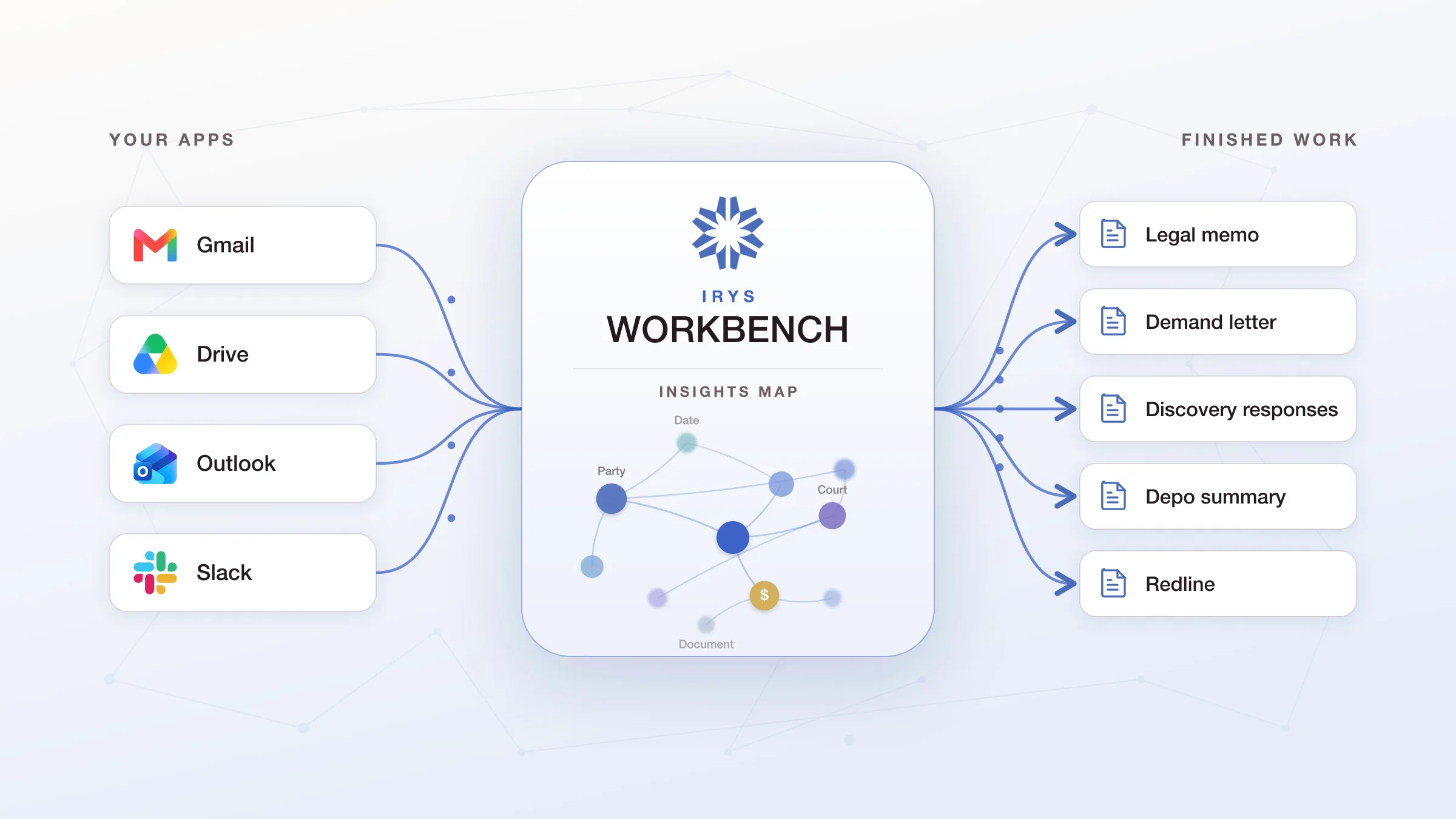
When you bring a matter into Workbench, Irys reads the files and lays them out on an Insights Map, a knowledge graph built the way a legal professional actually thinks about a case.
It isn't a folder of documents. It's the people, the dates, the money, the promises, and how they connect, each one traced back to the exact file it came from.
It relates the facts the way you would. It carries the history of the matter instead of starting over every time you open it. And it keeps an eye on what's coming, so the thing that matters surfaces instead of hiding on page 240.
Learning a new matter used to take a week of reading. Now it takes minutes. That is one of the things that makes Irys different: the understanding lives in your matter, and it gets sharper the more you work.
Research the law, grounded in your matter
Ask a legal question and Workbench researches real case law and statutes, guided by your matter's Insights Map, and gives you a clear answer with points linked to supporting authorities.
It drafts the real thing
Not a chat you copy out of, the finished file. A memo, a letter, an email, an exhibit index, in your format, ready to review. It writes; you hit send.
Everything, working from the same understanding
Because your matter has an Insights Map, everything you do draws on it: research, drafting and formatting, comparison, review against your playbook, and matter management, all in one place.
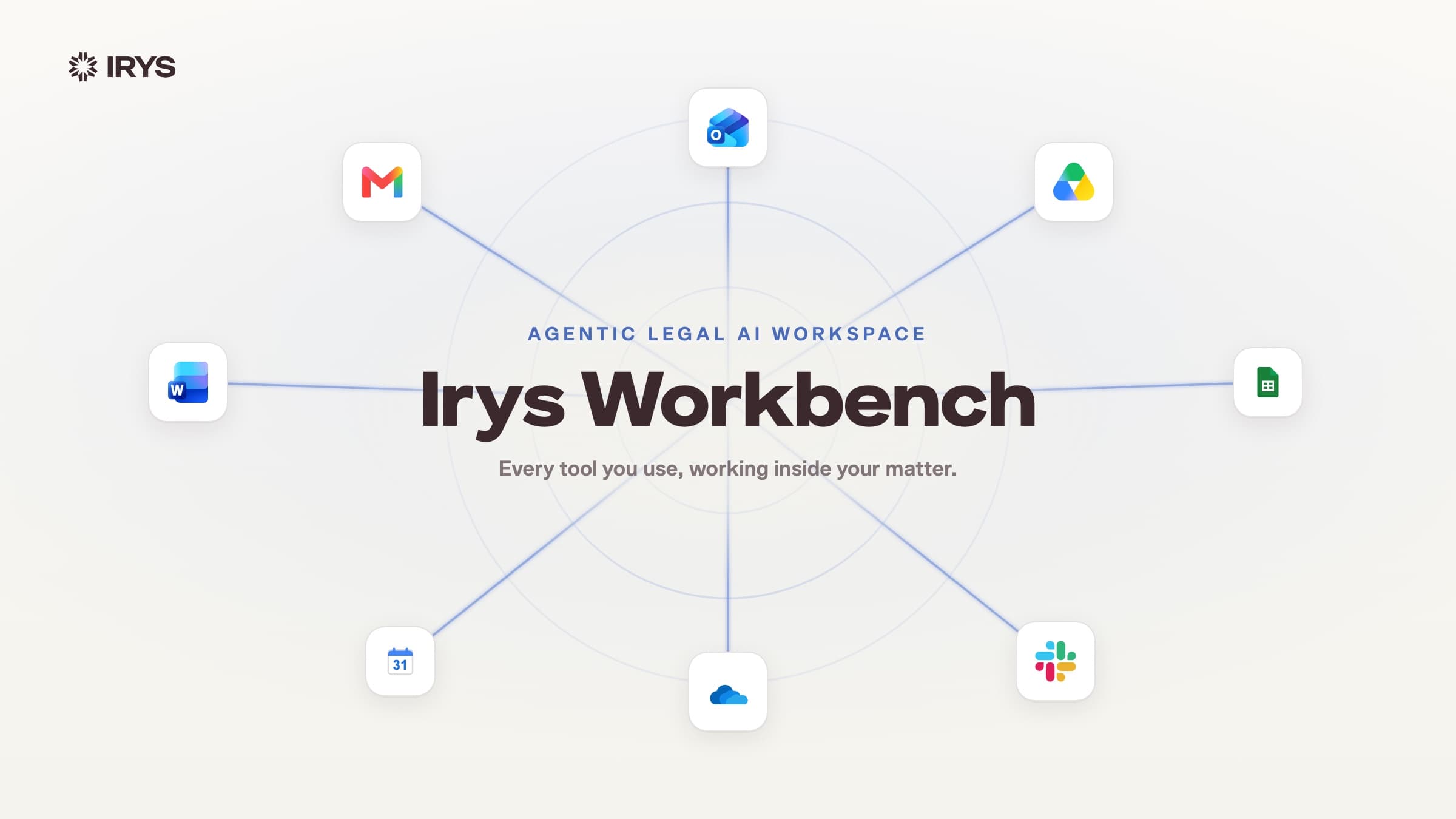
And it reaches the tools you already live in. Connect once, then pull exactly what you need, right inside a chat.
It shows its sources. It tells you what it couldn't verify. It writes drafts; you hit send. You decide what it can see.
One place, together
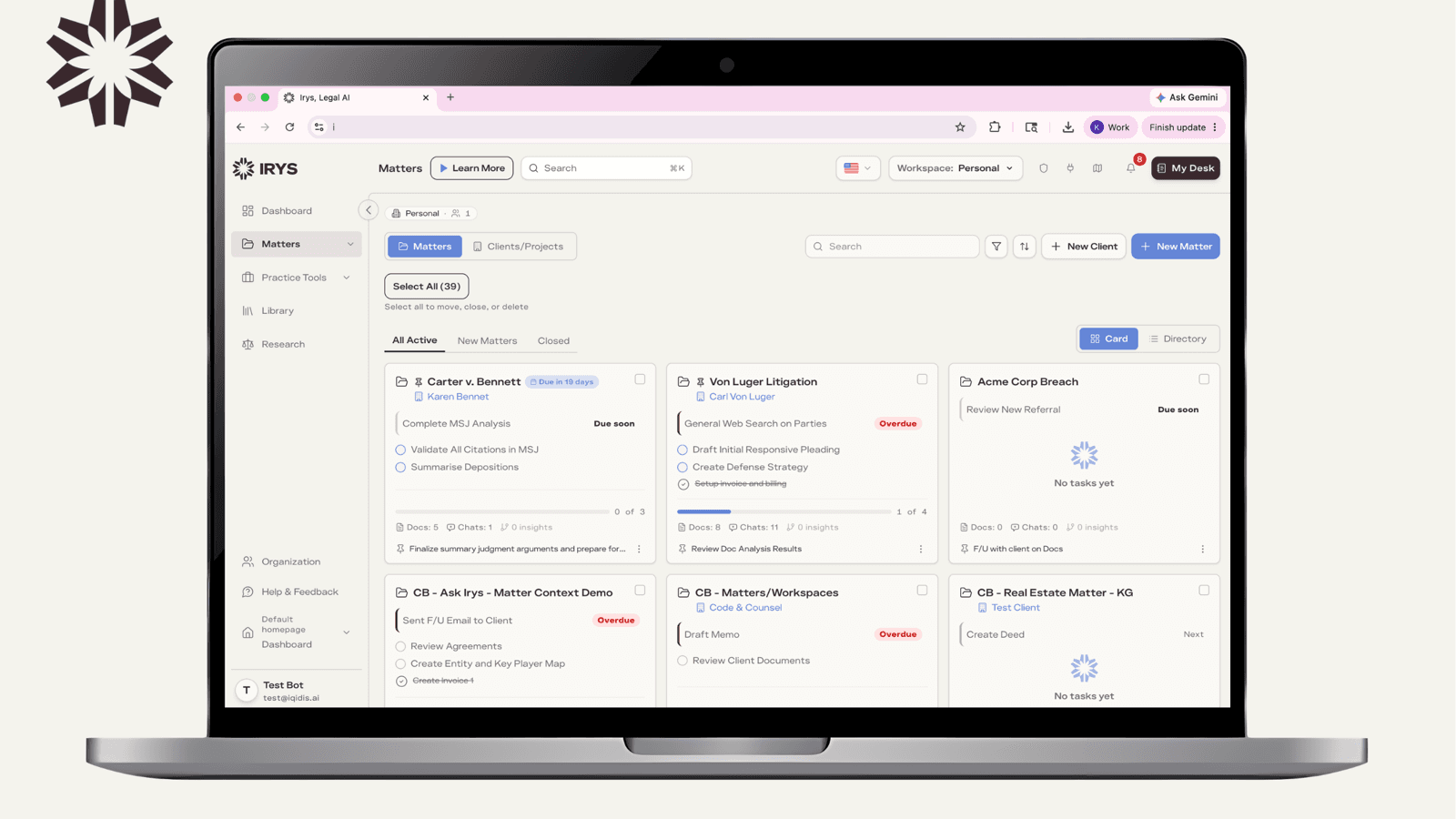
Your matters live in a Workspace. On your own, it's yours. With a team, it's shared, and that is where this really adds up.
In a shared Workspace, everyone works from the same Insights Map. The associate, the paralegal, and the partner see the same matter, the same history, the same connections, traced back to the same sources. The context stops living in one person's head.
Set your firm's playbook, positions, and templates once, and everyone works from them. The institutional knowledge that usually walks out the door when someone leaves, stays.
And it feels the same whether you're two or two hundred. For a two-person practice, it's shared context without emailing drafts back and forth. For a two-hundred-attorney firm, it's roles, permissions, SSO, and a shared library layered on top, without ever losing the feeling that the work still lives in one place.
Why it feels different
The first thing people notice is that it fits the way they already work.
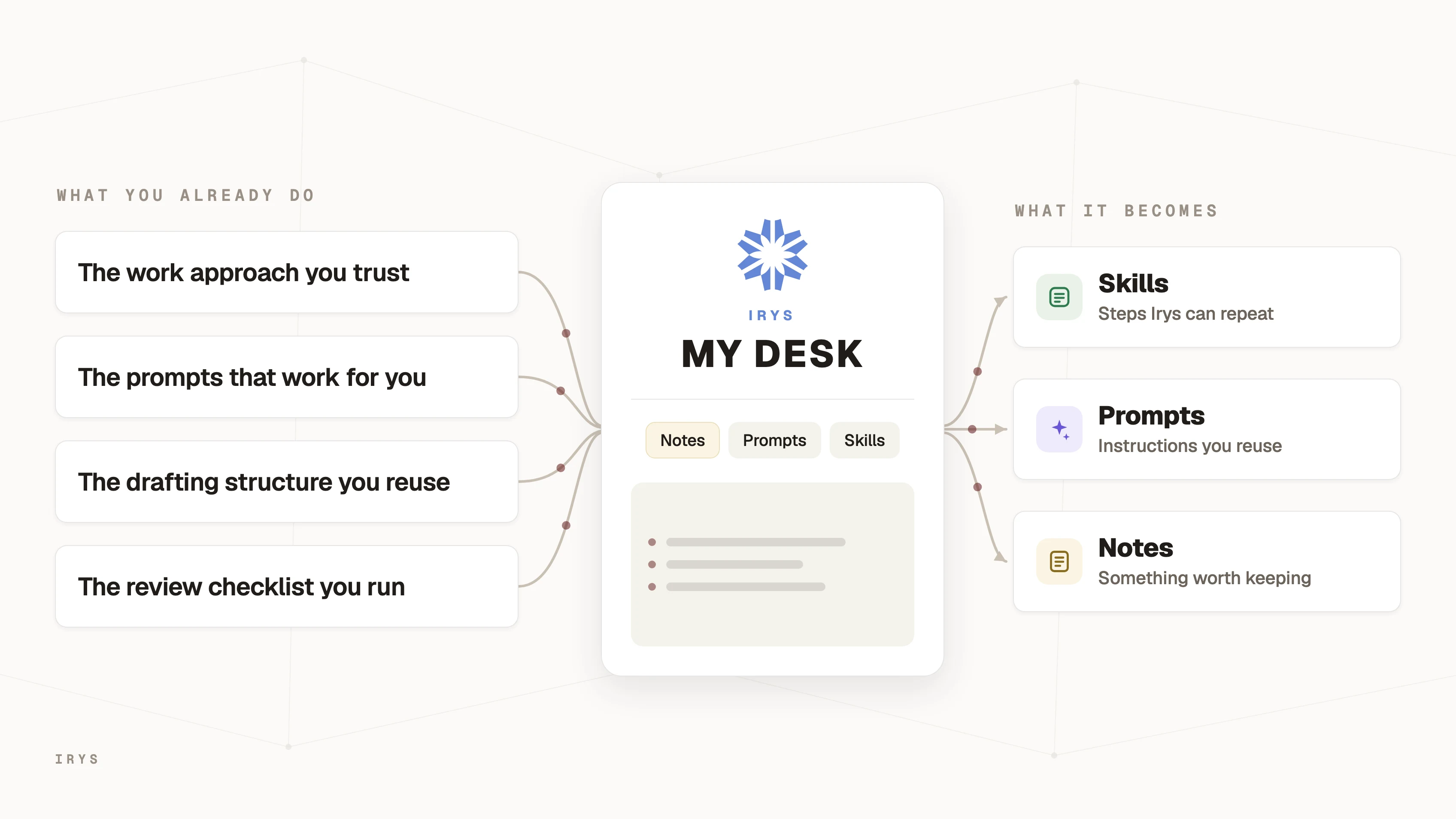
Nothing starts from zero. The memo you wrote last month, the deposition that shifted the analysis, the position you quietly moved off of, it's all still there, still connected, still working for you. The understanding lives in your matter and it compounds.
That is the difference between a tool that answers a question and something that actually supports how you practice: it relates the facts, carries the history, and shows you what's important next.
Here's the part I'd sit with. The way legal work gets done is changing, right now. The edge won't come from having the smartest model; everyone will have that. It'll come from having the structure to put it to work, matter by matter, over time.
You can feel that shift. The only real question is whether you see it on your own work before your peers do.
Get started
See it on your own matter
Bring one real, live matter and watch your Insights Map build in minutes. Seven-day free trial, no card. Irys One is a flat $299 a month, everything included, no token meter.
You didn’t get into law to be the glue between your tools. Come build with us.