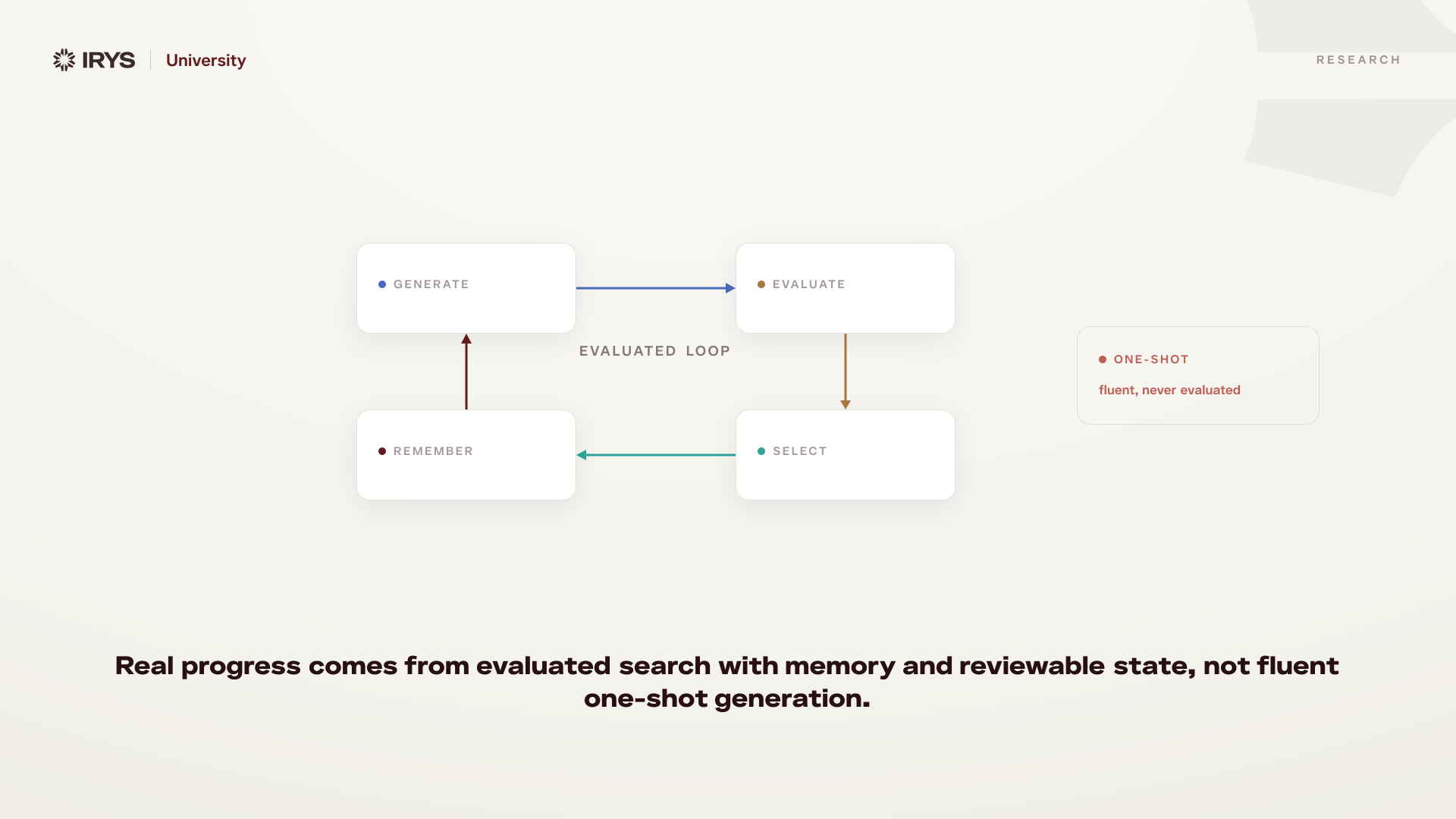
A fluent AI answer can look like work before it has earned the right to be used.
That is the pressure behind DeepMind's AlphaEvolve. The important idea is not that an AI system "evolves" in some vague biological sense. The important idea is that generated code stops being treated as an answer and starts being treated as a candidate.
A candidate can be run. It can fail. It can score better or worse than its parent. It can be stored with its result. It can be selected later because it survived a test.
That changes the job of the language model.
The model is no longer asked to be the judge, the memory, and the final authority. It proposes mutations. A user-defined evaluator decides which candidates survive. A program database preserves lineage and diversity. The next generation starts from selected ancestry instead of a blank prompt.
This is why AlphaEvolve matters. It turns fluent generation into cumulative search inside a world that humans have made machine-gradeable.
The boundary is just as important as the breakthrough.
AlphaEvolve works where candidates can be evaluated automatically. A scheduler heuristic can be simulated. A kernel can be timed. A matrix multiplication tensor decomposition can be checked. A candidate program can be executed against a test. The evaluator may be imperfect, expensive, or multi-stage, but the system has a survival mechanism outside the model's own confidence.
Legal work is different.
A motion is not correct because one function returns 0.91. A contract redline is not safe because it passed a synthetic benchmark. A research memo can be directionally right and still miss the controlling exception. A privileged document can be relevant and still unsafe to route into a broader workflow.
So the lesson for legal AI is not to copy AlphaEvolve literally.
The lesson is that serious AI work needs evaluated, remembered, reviewable state.
In legal work, that state looks like source-backed claims, checked citations, jurisdiction, procedural posture, caveats, reviewer decisions, redline scope, privilege boundaries, client instructions, and matter memory. Those objects have to survive the handoff. They have to remain inspectable when the next task begins.
If they disappear into a smooth paragraph, the system has not created work product. It has created text the lawyer now has to reconstruct.
Consider a research claim.
The weak version is a sentence in a memo: "The seller is likely liable under the indemnity provision."
The stronger version is a matter object. It has the source span. It has the citation. It has the governing jurisdiction. It has the contractual section. It has the fraud carve-out. It has the counterauthority. It has a confidence state. It has a reviewer note saying whether the team accepts the conclusion for this matter.
That object can do work later.
It can constrain a draft. It can warn a reviewer. It can explain a redline. It can be reused in a client update. It can be challenged without reopening the whole matter. It can fail locally if the quote is wrong, the jurisdiction is stale, or the reviewer rejects the posture.
That is the legal version of the AlphaEvolve pressure. The candidate should not survive because it reads well. It should survive because its support, limits, and review state remain attached.
This is also why "more context" is not the same thing as memory.
AlphaEvolve does not simply stuff every prior candidate into the next prompt. The program database gives the system a selection surface. It can preserve useful ancestry. It can keep diverse families of candidates alive. It can avoid collapsing too early onto the current best answer.
Legal matters need the same discipline in a different form.
A matter can contain a winning theory, a rejected theory, a caveat, a partner instruction, a client preference, an unresolved exception, and a redline that was rejected for a reason. If a system compresses all of that into one summary, the matter becomes easier to read and harder to trust.
The rejected branch may matter next week. The caveat may control the settlement posture. The partner instruction may explain why one clause cannot move. A later associate should not have to rediscover those facts from a transcript.
This is the product thesis behind matter-centric legal AI.
Irys is not useful because it can place a chatbot inside a legal interface. It is useful when the matter itself becomes the control surface: research, drafting, redlining, document comparison, review state, and institutional knowledge stay connected around the work.
The same principle applies to evaluation.
AlphaEvolve's evaluator is powerful because humans define the world in which candidates can be scored. That is a narrow kind of power. It should not be confused with universal truth.
Legal AI needs a softer but stricter set of gates. A citation can be checked against a source. A quote can be verified. A jurisdiction can be tagged. A redline can be compared against locked language. A reviewer can approve, reject, or narrow a conclusion. A privilege boundary can block reuse.
None of those gates proves the entire legal answer. Together, they make the work inspectable.
That is the difference between a generated answer and a governed matter workflow.
AlphaEvolve's official results are interesting because the same loop appears across different kinds of technical work: algorithm search, mathematical constructions, Borg scheduling, Gemini kernel tuning, TPU RTL simplification, and compiler optimization. But the results have to keep their shape.
The matrix multiplication claim is not "AI made matrix multiplication faster." It is a set of exact tensor-decomposition results across specified targets, including wins, matches, and misses. The kissing-number result is a lower-bound construction, not a proof that the exact answer is known. The Borg result matters partly because the evolved heuristic was interpretable, debuggable, predictable, and deployable. The kernel and compiler results apply to specific configurations and measured layers.
The caveat is part of the result.
Legal AI should be held to that same standard. A legal claim without its caveat is not a useful claim. A citation without the source span is not enough. A redline without the instruction that constrained it is not enough. A final memo without the route that produced it is hard to repair.
The deeper lesson is operational.
A system becomes serious when it can say what changed, why it changed, what evidence supported it, what boundary limited it, who reviewed it, and what the next task is allowed to reuse.
That is what legal teams actually need from AI. Not a prettier answer. Not a longer chat history. Not a model that claims to have reasoned through everything.
They need work product that can survive continuity.
A matter returns after a week. A partner asks for a narrower posture. A client asks why a clause moved. A new case changes the authority. A draft needs to be redlined against a prior version. The question is whether the system starts over or whether the matter already contains the inspected objects needed for the next step.
This is where Irys belongs in the AlphaEvolve story.
Not as "AlphaEvolve for law." That claim would be too loose.
Irys belongs as the legal-work translation of the same architectural standard: do not trust the surface alone. Preserve the state that lets the next user inspect, challenge, rerun, and reuse the work.
In legal AI, evaluated work means source-backed research, citation verification, scoped drafting, tracked redlines, reviewer decisions, matter memory, and audit trails that remain attached to the matter.
The final test is not whether the first answer sounds good.
The final test is whether the next task starts from preserved state.
Learn more about Irys at irys.ai, visit the Irys partner page, or book a demo.