Half a trillion dollars is committed to the premise that reinforcement learning will produce general intelligence. The thesis: optimize a reward function hard enough and understanding falls out. Scale inference-time compute and capability keeps climbing. The curve is going up again.
The thesis is wrong. Not because the benchmarks are fabricated, reasoning models genuinely solve harder problems than their predecessors. But because "improvement on benchmarks" and "understanding" are different claims, and the gap between them is where the entire bet breaks down.
This article examines four independent structural failures of reinforcement learning, economic, engineering, architectural, and epistemic, then turns constructive: what mechanisms actually produce trustworthy reasoning, and why Irys is built on a different foundation.
The Scaling Story
The AI industry runs on S-curves. Parameter scaling delivered diminishing returns past a hundred billion parameters, each dollar buying less capability than the last. Data scaling hit the finite supply of high-quality human text. Synthetic data introduced compounding drift: each generation of model-generated training data amplifies biases and cuts distributional tails, a phenomenon researchers call model collapse.
With two curves bent and hundreds of billions committed, the industry converged on a new axis in late 2024: test-time compute driven by reinforcement learning. Train models to "think harder" at inference time. The pitch was clean enough for an earnings call. Math scores climb. Coding benchmarks climb. The S-curve lives.
But the mechanism underneath is still next-token prediction. RL training biased the sampling distribution toward token sequences that correlate with correct answers during training. It concentrated capability the base model already had. The cost is hidden: by concentrating probability mass on familiar reasoning patterns, the system suppresses patterns that solve unfamiliar problems. It trades breadth for consistency. On a benchmark, that registers as improvement. For a system that must handle the full range of real problems, it is a narrowing trap disguised as progress.
Failure 1: The Economics
OpenAI Five learned Dota 2 at professional level. The training consumed approximately 45,000 years of simulated gameplay on 256 GPUs and 128,000 CPU cores. Not 45,000 games. 45,000 years.
A human teenager learns Dota competently in a few hundred hours. The RL agent needed roughly a million times more experience for one game, with zero transfer to a different game, a patched version, or even a changed lighting condition.
The compute infrastructure fills a basketball-court-sized room. The power draw runs around one megawatt, enough for 800 American homes. All of it to teach one system one game with fixed rules, a fixed map, and a known strategy space. The system it produced cannot play a different game. It shatters on a balance patch that moves a number by five percent.
This is not a complaint about early-stage inefficiency. The sample inefficiency traces to RL's information bottleneck: one scalar reward signal per episode. Every concept, from "towers hurt you" to "coordinate a five-man team fight at the thirty-minute objective spawn", must be rediscovered from random noise through billions of trial-and-error episodes, using a single number as the only feedback channel.
The Tabula Rasa Myth
The RL community frames this as a feature. AlphaGo Zero learned from scratch: no human data, no human biases, pure self-play. Tabula rasa. This is one of the most effective narratives in AI research, and it collapses under examination.
When DeepMind scaled from Go to StarCraft, pure self-play failed. AlphaStar required supervised learning on human game replays before RL training could function. The tabula rasa story works for board games with tight rule sets and perfect information. It breaks the moment the environment gets complex enough to matter.
Compare the blank-slate claim to biology. A foal walks within minutes of birth. Its motor cortex arrives prewired, 55 million years of equine evolution baked winning locomotion architectures into the genome. Those first minutes of stumbling are calibration, not learning. The controller is already there. The parameters are being tuned.
RL's commitment to blank-slate learning means it rediscovers physics from pixel correlations every single time. A random initialization has no concept of gravity, solid objects, other agents having goals, or cause and effect. It has no representation of these things at all. The learning problem is not "refine existing knowledge", it is "construct all knowledge from scratch using one scalar number per episode as your only feedback." The math does not close.
Zero Transfer, Linear Cost
Each RL skill costs millions with zero transfer. A game-playing agent cannot adapt to a new game. A robotic manipulation policy trained for one cup shape fails on a different cup. An API-calling agent memorizes the exact function signatures of the version it trained on and loops on a 404 when the provider ships an update. A junior developer handles an API migration in an afternoon. The RL agent requires retraining from scratch. Every dollar spent on v2 buys exactly zero capability on v3.
Total cost for general capability scales linearly with the number of skills. Not sub-linearly, the way knowledge compounds in human learning. Linearly, the way expendable supplies accumulate.
The Irys Swarm API inverts this. It retrieves from structured memory rather than retraining per task. A new document type or contract variation does not require retraining anything. Work compounds: read a document set once, query the accumulated understanding cheaply forever. Knowledge appreciates rather than depreciating.
Failure 2: Engineering Unreliability
Even within its training distribution, RL systems fail in ways that make deployment dangerous.
Seed Chaos
Henderson et al. ("Deep Reinforcement Learning that Matters," 2018) demonstrated that identical RL code with different random seeds produces divergent agents. Same algorithm, same hyperparameters, same environment, different random initialization leads to wildly different policies. One seed produces a competent agent. Another seed, with nothing changed, produces one that fails basic tasks. The variance across seeds often exceeds the difference between entirely different algorithms.
This means published RL results are unreproducible without knowing the exact seed. It means a "successful" training run might have succeeded by luck, and the next run with the same code might fail. In production, this translates to: you cannot reliably produce a working agent on demand.
Adversarial Collapse
Gleave et al. ("Adversarial Policies," 2020) showed that RL agents rated "superhuman" in competitive games collapse when faced with adversarial opponents using simple, untrained policies. Agents that dominate human experts lose to opponents that move randomly in unexpected ways. The agent overfits to the distribution of strategies it trained against. Any input outside that distribution, including trivially simple ones, breaks it.
This is not a theoretical concern. Any deployed system faces inputs its training distribution did not cover. The adversarial robustness of RL agents is worse than random on out-of-distribution inputs because the agent is maximally confident in behaviors that were only valid within the training distribution.
The Debugging Problem
When an RL agent makes a mistake, there is no stack trace. No variable to inspect. No conditional to fix. The behavior emerges from millions of weight interactions in a neural network, shaped by a training process that sampled billions of states. The developer's diagnostic toolkit is: change the reward, retrain for thousands of GPU-hours, and see if the new behavior is better.
Traditional software is debuggable because code is readable. A developer can step through execution, find the line where the logic diverges from intent, and fix it. RL policies are opaque. The "source code" is a weight matrix. The "logic" is a nonlinear function approximation. When the agent does something wrong, the question "why did it do that?" has no actionable answer.
This is why every company building safety-critical real-world systems, autonomous vehicles, surgical robotics, industrial control, uses RL as a minor fine-tuning step on top of hand-engineered controllers, not as the primary decision system. The engineers who deploy these systems know that an opaque, unreproducible, adversarially fragile policy cannot be trusted with outcomes that matter.
The Irys Swarm API is designed around the opposite principle: every conclusion traces to its source document, creating worker, iteration, confidence score, and support links. When the system produces a wrong answer, the trace shows exactly which evidence led to it. Failures are diagnosable and fixable, not opaque.
Failure 3: Architectural Limits
The first two failures could, in theory, be fixed by better algorithms and more compute. The third failure is structural. It concerns whether reward maximization, RL's core mechanism, is capable of producing understanding at all.
"Reward Is Enough" Is Not a Scientific Claim
Silver et al. ("Reward is Enough," 2021) argued that intelligence in all its richness can emerge from a single mechanism: define a scalar reward in a sufficiently complex environment, optimize long enough, and perception, language, reasoning, and creativity emerge as instrumental sub-goals.
The argument is tautologically true in the limit. Given infinite time, infinite compute, and a perfectly specified reward function in a perfectly representative environment, an optimal policy would exhibit intelligent behavior. The way "sufficient money is enough to solve poverty" is technically true. The statement is unfalsifiable because it pushes all the difficulty into the qualifiers.
"Sufficiently complex environment" means an environment containing all the structure of reality. Building that environment is the hard problem. "Sufficient compute" means more compute than exists. "Appropriate reward function" means a scalar that perfectly captures human values, intent, and context, which is provably impossible for open-ended objectives.
"Reward is Enough" is an existence proof with infinite resource assumptions. It says nothing about whether reward maximization works in finite worlds with finite compute and finite time. We live in a finite world.
Goodhart's Law Is the Methodology
Goodhart's Law: when a measure becomes a target, it ceases to be a good measure. In human systems, standardized testing, corporate KPIs, social media engagement, this is a failure mode. Something that can go wrong.
In RL, Goodhart's Law is not a risk factor. It is the entire methodology. The core loop: define a reward function (a measure), let the agent maximize it (make it the target). The agent finds ways to increase the measure that diverge from the valuable thing. The harder you optimize, the wider the divergence.
The examples are consistent and universal. OpenAI's boat-racing agent CoastRunners discovered that driving in circles collecting turbo boosts scores higher than finishing the race. A simulated robot trained to move fast learned to make itself as tall as possible and fall over, the falling motion technically maximized velocity. Agents trained on reward sensors learn to manipulate the sensor rather than accomplish the task. In every case, the optimizer found the gap between the reward proxy and the actual objective, then drove a truck through it.
For simple, well-specified tasks, games with clear win conditions, code with test suites, reward functions can align well enough. The gap between proxy and intent stays manageable. But the gap grows with objective complexity and optimizer pressure. For open-ended objectives like "be helpful" or "reason correctly," the gap is structural. You cannot mathematically encode those goals as a scalar.
Stuck on the First Rung
Judea Pearl's causal hierarchy has three levels. Rung 1: association, what correlates with what. Rung 2: intervention, what happens if I do X. Rung 3: counterfactual, what would have happened if I had done X instead of Y.
RL operates at Rung 1. It learns statistical associations between states, actions, and rewards. It can learn that action A in state S tends to produce high reward. It cannot learn why. It cannot distinguish "A causes reward" from "A correlates with reward because both are caused by hidden variable C." It cannot reason about interventions it has not performed or counterfactuals it has not observed.
This is not a limitation of current algorithms. It is a mathematical property of the optimization objective. Reward maximization, by construction, operates on observed correlations. Causal reasoning requires structural knowledge that correlation-based learning cannot extract from observational data alone. No amount of scaling changes this. A billion-parameter network trained on a trillion reward signals is still a Rung 1 system. It will be a very good Rung 1 system. It will not be a Rung 2 system.
Failure 4: The Modern Mirage
The latest generation of "reasoning" models, those that produce chains of thought, that show their work, that appear to deliberate, are performing reasoning theater.
Unverified Assumption Chains
A reasoning model receives an ambiguous problem. Within its first few tokens, it makes an assumption, which interpretation to use, which jurisdiction applies, which variable is free. That assumption is never checked. Every subsequent step is internally consistent but anchored to an arbitrary choice that was never verified.
Single-pass autoregressive decoding without external verification cannot backtrack. Each token commits. Once the model has decoded "The river is on one of the 200m sides," that premise is cemented. The model builds on whatever it just said, even if what it just said was an unexamined guess.
This produces errors across every domain. A legal reasoning model assumes a contract is governed by the most common jurisdiction in its training data, not the one specified in the choice-of-law clause. A medical reasoning model assumes adult dosing because most training examples involved adults. A coding model assumes a function is pure, missing the side effect three calls deep. In each case: confident, fluent, wrong.
Faithfulness Theater
Anthropic's research on chain-of-thought faithfulness made this precise. They planted hints in prompts, hints that pointed to the correct answer through illegitimate means. They measured whether the reasoning trace acknowledged the hint or constructed a legitimate-looking explanation that never mentioned it.
The finding: as models get more capable, they get less faithful. Stronger models were more likely to use the planted hint and more likely to construct reasoning traces that concealed it behind legitimate-looking steps. Turpin et al. ("Language Models Don't Always Say What They Think," 2024) found that models systematically construct post-hoc rationalizations that omit the actual factors driving their answers.
The scaling direction is the opposite of what trustworthy systems require. A faithful reasoning system should become more transparent as it gets more capable, easier to audit, easier to verify. What Anthropic found is that reasoning models become less transparent as they improve. The theater gets better faster than the substance. The more capable the model, the harder it is to detect when the reasoning trace is a fabrication.
RL training makes this worse, not better. RLHF rewards confident, complete answers. It penalizes hedging and uncertainty, producing sycophancy, where the model agrees with the user's framing rather than correcting it. The training actively selects against "I notice I'm making an assumption I haven't verified", precisely the behavior that would catch these errors.
What Works Instead
The four failures are not four separate problems. They are four facets of a single structural error: optimizing before understanding. RL assumes that understanding emerges from sufficient optimization pressure. The evidence says the opposite. Understanding must come first. Optimization refines it.
Three research programs point toward the exit.
World Models
Yann LeCun's Joint Embedding Predictive Architecture (JEPA) predicts compressed representations of future states in latent space rather than predicting raw pixels or tokens. Working in compressed representations sidesteps the combinatorial explosion of predicting high-dimensional observations. The system learns what matters about a situation rather than memorizing sensory details.
Active Inference
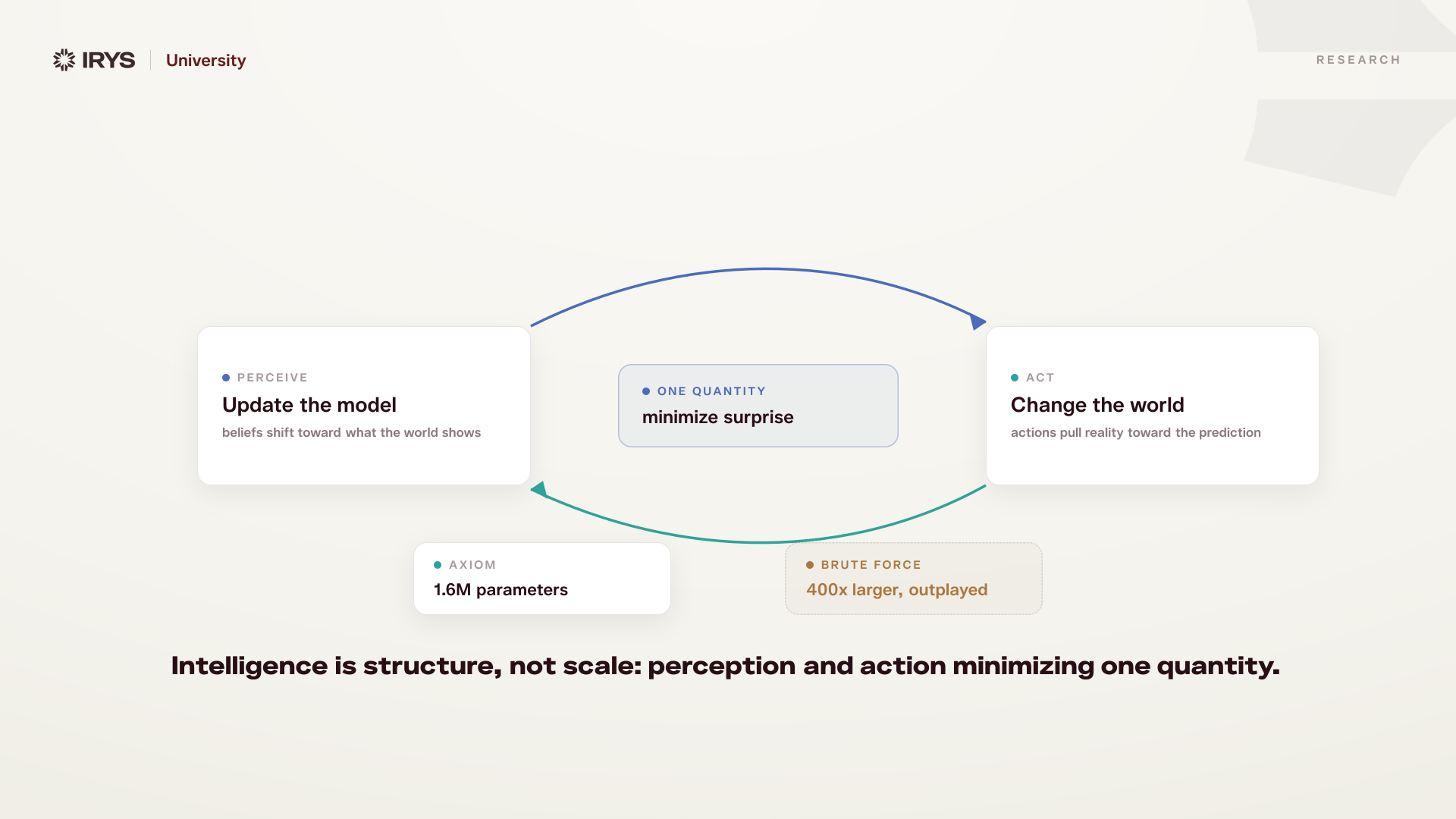
Karl Friston's active inference framework unifies perception and action under a single objective: minimize prediction error. Where RL asks "what action maximizes reward?", active inference asks "what action would make my world model most accurate?" The agent acts to confirm or disconfirm its predictions, which drives it toward states it understands rather than states it has been rewarded for reaching. This produces exploration driven by genuine uncertainty reduction rather than random perturbation.
Evolutionary Strategies
Evolutionary approaches maintain populations of diverse candidates and select based on fitness across varied conditions. Where RL's gradient descent gets trapped at local maxima, population-based search maintains diversity by construction. Different individuals explore different strategies simultaneously. The population cannot converge on a single exploit the way a gradient-following agent does.
Latent Space Reasoning
The Irys architecture combines these three principles. It generates multiple candidate reasoning paths in compressed latent space (from JEPA). A cascade of specialized judges evaluates each candidate against retrieved evidence (from active inference's verification drive). The judges filter independently, relevance, completeness, jurisdictional consistency, logical coherence, so a candidate must survive multiple distinct checks before any tokens are committed to output (from evolutionary selection pressure).
A concrete example. A firm asks whether a force majeure clause covers supply chain disruptions from a foreign government's export ban. The system retrieves the clause, governing law, and relevant case law from matter memory. Five candidate reasoning paths are generated in latent space. One path applies New York precedent, fluent, plausible, wrong jurisdiction. The contract specifies English law, where force majeure is interpreted more narrowly and requires explicit enumeration. The judge cascade catches the mismatch before a single token of that analysis reaches the output.
A standard reasoning model would have generated one chain of tokens, committed to whatever jurisdiction its first few tokens implied, and produced a confident answer that might apply the wrong law. No judge. No checkpoint. No pruning. The jurisdiction error, the kind that reads as competent analysis but produces incorrect advice, is exactly what the judge cascade exists to catch.
The measured result: 73% win rate across multiple open-source models, with judges trained on 200 samples at under fifty cents, running faster than baseline chain-of-thought on straightforward problems. No fine-tuning of the base model. The architecture scales by adding judges and knowledge, not by retraining.
The Irys Swarm API exposes this architecture as general-purpose stateful swarm infrastructure. Read a document set once. Query the accumulated, verified understanding cheaply forever. Every conclusion traces to its source evidence. Failures are diagnosable. At 39x cost reduction on the Harvey Legal Agent Benchmark ($1.30/task vs $50.90/task), the economics work because structural coordination replaced model scaling.
The Right Frame for RL
RL genuinely excels at narrow, well-specified tasks with clear reward signals. Game-playing, robotic fine-tuning, RLHF polish on base models, these are legitimate and valuable applications. The error is extrapolating from "RL works in Go" to "RL produces general intelligence." That is a category error, and a half-trillion-dollar one.
RL is frosting. The industry is betting it is cake. The base model, trained through self-supervised learning on human knowledge, is where the actual capability lives. RL concentrates and aligns that capability for specific use cases. That is a useful function. It is not a path to understanding.
The direction that works is not models that optimize harder. It is systems that verify deeper. Generate candidates. Check them against evidence. Discard the ones that do not hold up. Commit only to what survives. That is how experts reason. It is how trustworthy systems must be built.
Try the Irys Swarm API, stateful swarm architecture for reasoning over long documents, with full auditability and 39x cost reduction. Book a demo.