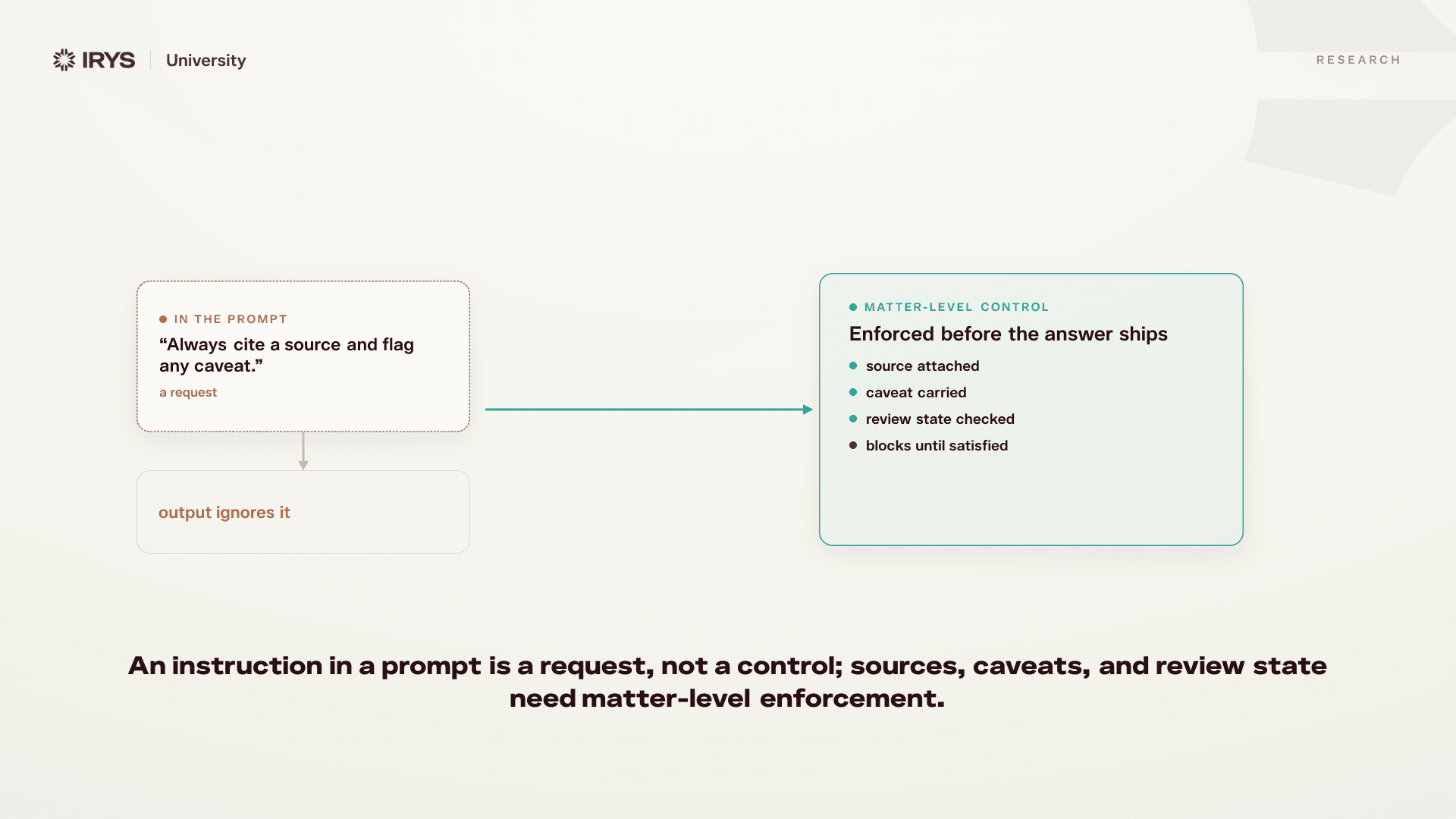
A lawyer can give a model a careful instruction and still lose the thing the instruction was meant to protect.
That is one of the quiet failure modes in legal AI. The prompt says to preserve caveats, cite sources, avoid overstatement, and keep unresolved issues open. The first answer may do all of that. The problem starts when the work moves from one answer into the next task.
A research answer becomes a client update. The client update becomes a draft. The draft becomes a redline. A partner adds an instruction. A second lawyer asks a narrower question. The system still has the original instruction somewhere in the chat, or in a summary of the chat, or in a longer prompt. But the instruction is not the same thing as control.
Control has to survive the current answer.
Consider a simple contract review. The first answer says the seller indemnifies the buyer, subject to a fraud carve-out. It cites the agreement. It sounds careful. Then the team asks for a shorter client-facing version. The second answer says the seller indemnifies the buyer under Section 8.2. That sentence is clean, but the carve-out no longer governs the conclusion.
The model did not necessarily ignore the user. The workflow never made the carve-out enforceable.
The caveat was prose. The source was prose. The partner instruction was prose. The unresolved issue was prose. Once those objects are flattened into a paragraph, the next step has to infer what should survive.
Legal work is not built that way. A source is not the same thing as a claim. A caveat is not the same thing as a conclusion. A partner instruction is not the same thing as a footnote. A blocker is not the same thing as a warning buried in a sentence.
Each object has a job.
The source supports or contradicts a claim. The caveat limits the conclusion. The partner instruction governs a later drafting choice. The blocker prevents finalization until a condition is resolved. Review status tells the next task whether the object can be relied on.
If all of those jobs are handed to prompt text, the prompt becomes overloaded. It has to be memory, policy, evidence, review log, and drafting instruction at the same time. A longer prompt can hold more text, but it does not automatically preserve the role of each object.
This is where matter-centric legal AI matters.
In Irys, the work behind the answer should remain separate enough to inspect and use. The claim is an entry. The source is linked. The caveat is its own object. Confidence and review status are fields. A partner instruction can apply to a draft because it is stored as matter state, not as a sentence the model may summarize away.
That changes the next task.
The client update does not inherit only the prior paragraph. It inherits the objects behind it. The redline can see the caveat. The follow-up research question can follow the source. A later draft can obey the partner instruction because the instruction still exists as a governing object.
The prompt remains useful. It is how the lawyer asks the next question. But it should not be the only place where the matter's controls live.
Legal AI becomes safer when the system can answer a sharper question: what must survive after this answer is gone?
If the answer depends on a caveat, the caveat needs durable identity.
If the draft depends on a partner instruction, the instruction needs to govern the draft.
If a claim depends on a source, the source link needs to survive the handoff.
The goal is not longer prompt engineering. The goal is work product that carries its own controls forward.
Learn more about Irys at irys.ai or visit the Irys partner page.