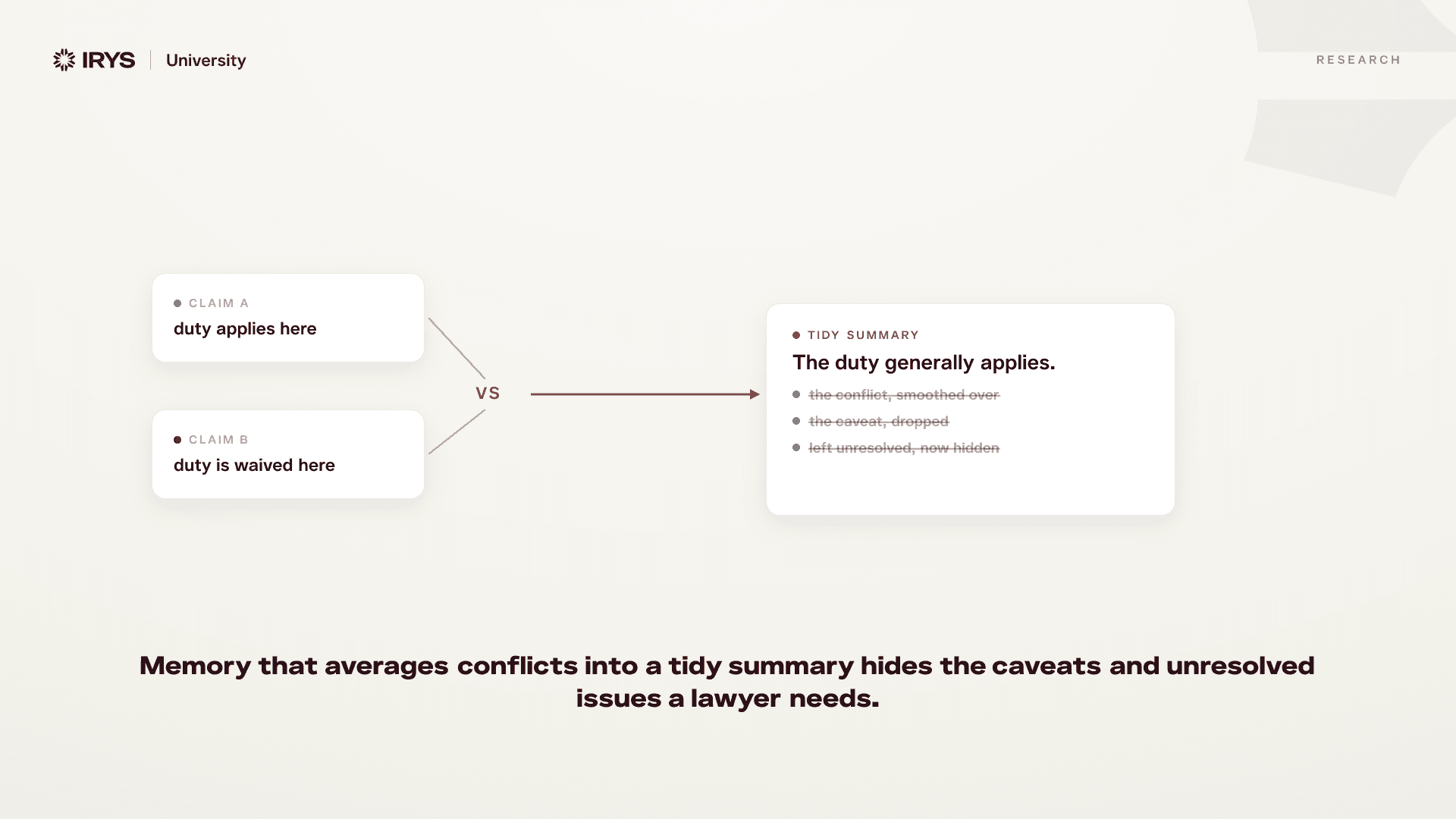
Summaries are good at producing a clean middle. Legal work often depends on the part that refuses to become clean.
That is a problem for legal AI memory. A matter can contain a main rule, an exception, a partner instruction, a source limitation, and an unresolved conflict. If the system compresses those objects into one smooth paragraph, the paragraph may read better while the work becomes less reliable.
Legal reasoning often turns on contradiction.
The contract says the seller indemnifies the buyer. The carve-out says the cap does not apply in fraud. One case supports the standard. Another narrows it in this procedural posture. A client wants an aggressive position. A partner says not to take that position unless the fallback fails.
Those tensions are not noise. They are the matter.
A summary may resolve the tension too early because a summary wants to be useful, short, and readable. It tends to keep the shared center and drop the awkward edge. The result can become more fluent as it becomes less safe.
The answer says: seller indemnifies buyer under Section 8.2.
That sentence may be true as far as it goes. It is also incomplete if the fraud carve-out changes the conclusion. The problem is not only that the exception is missing. The problem is that the contradiction between the main rule and the exception was never preserved as a working object.
Matter memory should behave differently.
It should not average the claim and the caveat into a compromise sentence. It should keep both. The indemnity claim remains visible. The fraud carve-out remains visible. The source spans remain attached. The conflict between them becomes an edge the workflow can inspect.
That design changes what later work can do.
A draft can see that the claim is blocked. A client update can say the answer depends on resolving the carve-out. A reviewer can mark the issue open. A later research task can reopen the exact source rather than asking the model to infer that something might be missing.
This is the point of matter-centric legal AI. The system should preserve the objects that have future jobs.
Some objects support a conclusion. Some limit it. Some contradict it. Some need review. Some apply only to one draft. Some have been superseded. If those roles disappear into prose, the next task starts with a clean paragraph and no way to know what was lost.
In Irys, memory should be structured around the matter, not around the last answer. Documents, chats, generated work product, review state, source links, caveats, and unresolved issues should stay connected because later legal work depends on those connections.
The goal is not to make memory longer. Longer memory can still lose structure.
The goal is to make memory more faithful to the work.
That means preserving contradictions until someone resolves them. It means letting a caveat remain a caveat instead of turning it into a softer sentence. It means letting an open issue stay open across research, drafting, redlining, and client communication.
Legal teams do not need AI that always smooths the matter into an answer.
They need AI that knows when the matter should stay rough.
The clean summary is useful only after the legal conflict has been handled. Before that, the conflict needs to survive.
Learn more about Irys at irys.ai or book a demo.