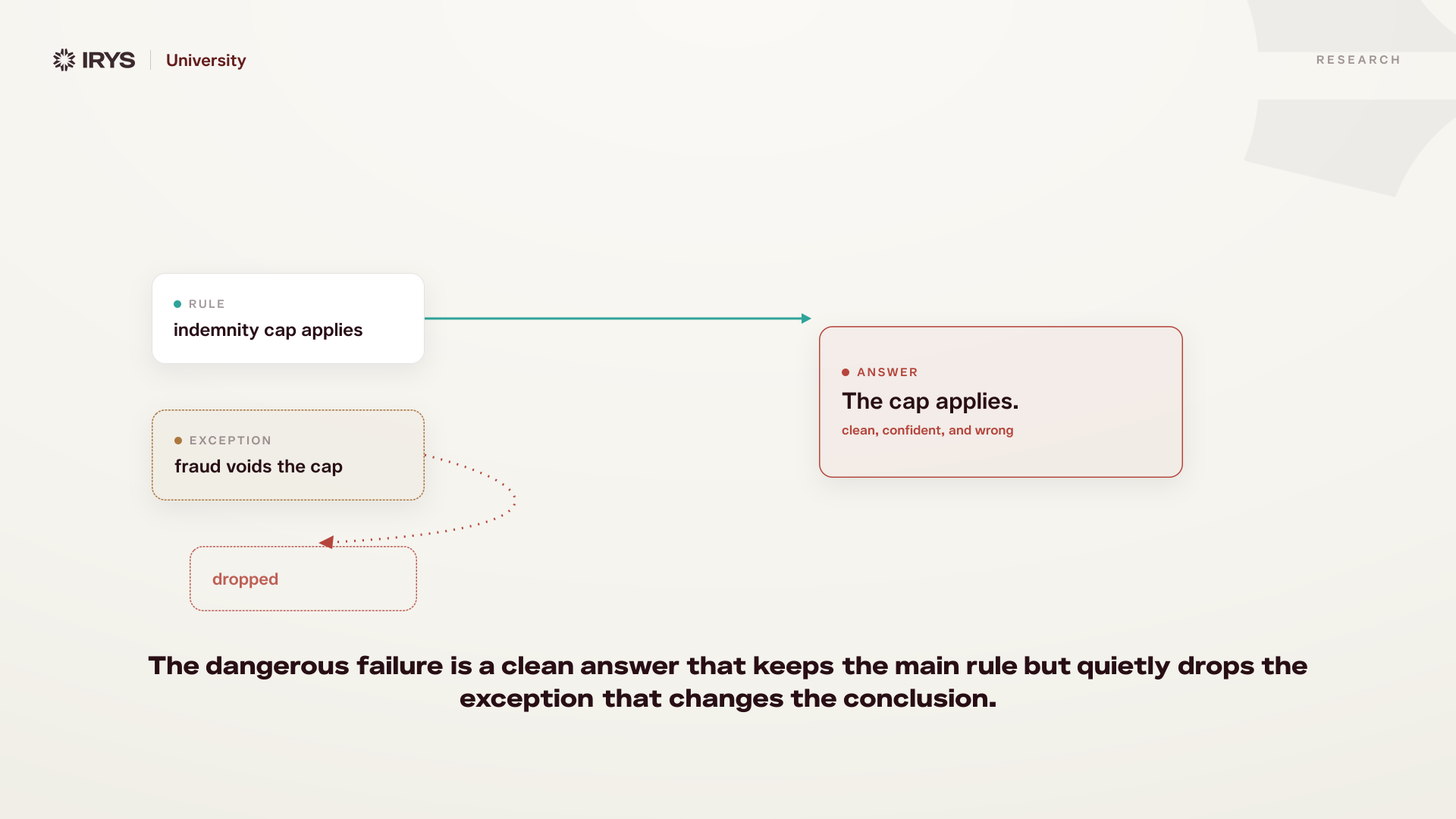
The most dangerous legal AI answer often looks close enough to trust.
It names the right agreement. It cites the right section. It gives the expected rule. The seller indemnifies the buyer. The clause creates the obligation. The case supports the standard.
Then the exception appears five lines lower.
The cap does not apply in cases of fraud. The forum clause has a carve-out. The privilege rule changes if waiver occurred. The deadline applies only after proper notice. The partner instruction applies only if the fallback position fails.
That small object changes the work.
This is the exception leak: the system keeps the main rule and loses the legal edge that controls the conclusion.
The failure is easy to miss because the answer still sounds legal. It may even cite the right source. The model did not invent a fake clause or forget the whole document. It preserved the center and dropped the boundary condition.
Legal work is full of those boundary conditions. A short qualifier can decide whether a claim survives, whether a clause applies, whether a risk is material, whether a draft position is acceptable, or whether a client update needs escalation.
Summaries are especially vulnerable to this failure.
The first pass reads the clause and writes: seller indemnifies buyer, subject to the fraud carve-out. The second pass compresses that to: seller indemnifies buyer under Section 8.2. The third pass drafts from the compressed version. The answer is fluent, confident, and wrong.
Nothing dramatic happened. The exception became ordinary prose. Then it became optional prose. Then it disappeared.
A bigger context window does not solve this by itself. The window may hold the exception, but it does not decide that the exception outranks the clean summary. The system has to preserve the exception as the kind of object the workflow can act on.
In a matter-centric workflow, the indemnity claim and the fraud carve-out should not be forced into one smooth sentence. The claim is one object. The carve-out is another. The source span stays attached. The conflict between them is visible. If a final answer ignores the carve-out, the workflow should block or route the answer back for review.
That is the difference between text memory and matter memory.
Text memory remembers what was said. Matter memory preserves what has to remain operational.
The exception needs to remain active because later work depends on it. A redline may need it. A client update may need it. A research follow-up may need it. A partner review may need to know whether the exception was considered and resolved.
If the exception is only a phrase inside a prior answer, every later task has to rediscover its importance.
If the exception is a source-backed object, the workflow can use it.
This is one of the reasons Irys is built around matter context rather than disconnected chat turns. The legal team should be able to see the claim, the caveat, the source, the conflict, and the review status as pieces of work that survive handoff.
A useful legal AI answer can cite the rule.
A reliable legal AI workflow preserves the exception that changes the rule.
That is the real test. Not whether the first answer sounded careful, but whether the legal object that mattered was still alive when the next task began.
Learn more at irys.ai or book a demo.