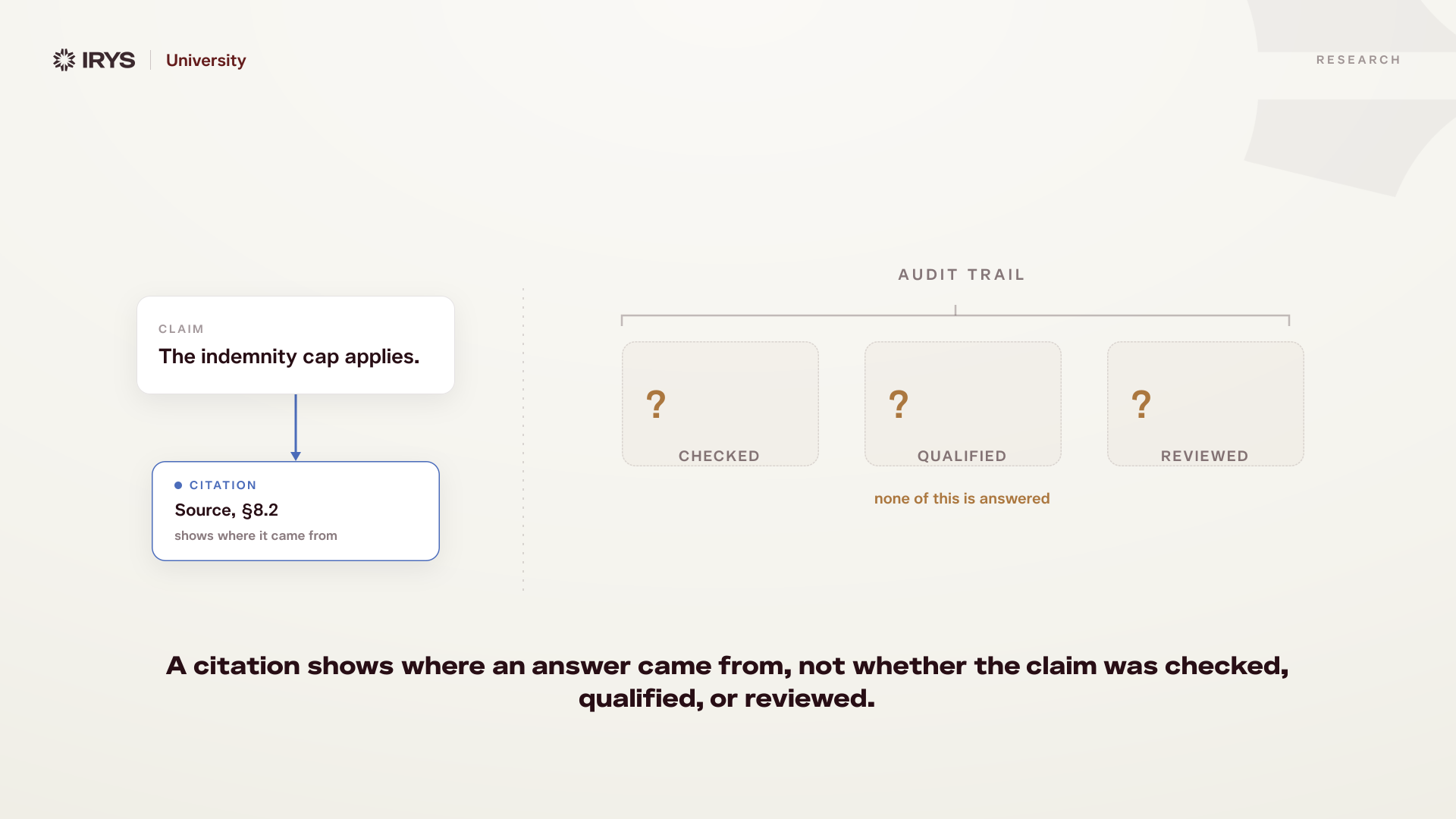
A citation can tell a lawyer where to look. It cannot, by itself, explain how an AI answer was built.
That distinction matters. Many legal AI systems treat citations as if they solve auditability. The answer says the seller indemnifies the buyer. A footnote points to Section 8.2. The page opens. The source exists.
That is useful. It is not enough.
The reviewer still needs to know which sentence in the answer depends on which source span. The reviewer needs to know whether the source was quoted, summarized, or inferred from. The reviewer needs to know whether a caveat was present nearby. The reviewer needs to know whether another worker challenged the claim. The reviewer needs to know what confidence attached to the extraction and whether a human approved it.
Those are different questions. They need different objects.
A citation is a pointer. A claim is a proposition. A quote is evidence. A support edge connects a claim to evidence. A confidence score measures an extraction. A reviewer note records judgment. A blocker prevents finalization. An audit trail records the path through the work.
When those objects collapse into one paragraph, the system loses control over them.
It can show a citation, but it cannot test whether the citation supports the challenged sentence. It can show confidence, but it cannot explain which step produced it. It can include a reviewer comment, but it cannot make that comment govern the next draft.
Legal teams already understand this in human work. A junior associate's memo is not trusted because it has footnotes. It is trusted when the reasoning can be followed, the sources can be checked, the limitations are visible, and the partner can see what was reviewed.
AI-generated legal work should meet the same standard.
That means auditability has to be matter-level. The answer is one object. The claim behind the answer is another. The fact supporting the claim is another. The quote, source, worker, confidence, contradiction edge, and review status each have their own role.
In Irys, the work behind the answer is part of the product. A lawyer should be able to challenge a sentence and follow the path backward: answer to claim, claim to fact, fact to quote, quote to source, source to worker and review status.
That path changes the review process.
Without a path, the lawyer has to trust the paragraph, reject it, or manually reconstruct the work. With a path, the lawyer can inspect the support, find the missing caveat, correct a relation, and preserve the parts that were right.
This is not extra documentation. It is how AI-generated text becomes usable work product.
The difference becomes clear when an answer is almost right. Suppose the answer cites the correct contract section but misses the fraud carve-out in the same section. A citation alone tells the reviewer where the source is. An audit trail can show that the carve-out was never connected to the claim.
Those are different levels of control.
The citation helps the lawyer look.
The audit trail helps the system repair.
Legal AI will not be trusted in real matters because it sounds fluent or because it can produce a footnote. It will be trusted when the work behind the text remains visible enough to inspect, challenge, correct, and reuse.
A citation is a starting point.
The product needs the path.
Learn more about Irys at irys.ai or visit the Irys partner page.