The hard part of supervising legal AI is not always catching nonsense.
Often, the harder problem is preserving corrections.
A lawyer reviews an answer, finds a limitation, narrows the conclusion, attaches a better source, or marks an issue unresolved. If the system treats that correction as a one-time edit to a paragraph, the correction dies inside the paragraph. The next memo, redline, or client update can drift back toward the earlier mistake.
At that point, auditability becomes product, not compliance decoration.
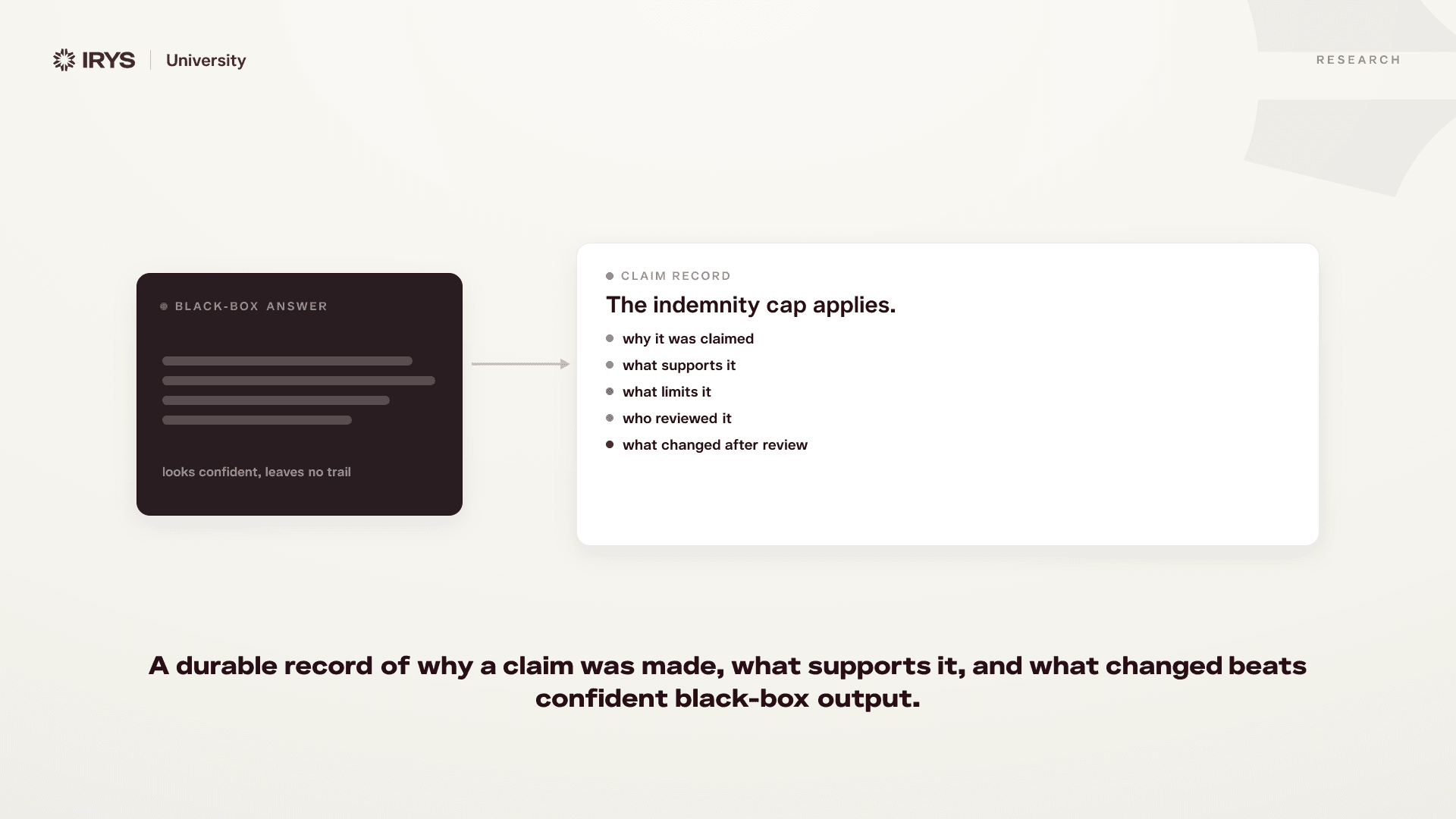
Legal AI work product needs a durable record of why a claim was made, what supports it, what limits it, who reviewed it, and what changed after review. The visible paragraph is only the last surface. The more important object is the claim record behind it.
The Research Memo Failure
Suppose a litigation team asks whether a particular claim is likely to survive a motion to dismiss.
The system reads a complaint, a few cases, and a prior internal memo. It drafts a short answer: the claim is likely to survive because the pleaded facts satisfy the required elements under the cited standard.
The answer looks useful. It names the standard. It cites a case. It mentions the allegations.
But the prior internal memo included a limitation: the strongest case applied a more plaintiff-friendly state pleading rule, while the current matter is in federal court. Another case in the research set narrows the same element in a way that matters for this complaint. The answer cited the favorable authority but did not carry forward the limitation.
Call it a near-correct failure. It isn't a hallucination in the cartoon sense. It is worse for a legal team because the work looks grounded while the support record is incomplete.
The lawyer needs to know which relation failed.
Did the system miss the limiting case entirely? Did it extract the case but fail to attach the limitation to the conclusion? Did it recognize the forum distinction and then lose it during synthesis? Did the final draft overstate a claim that should have remained qualified?
Those are different defects. A serious product cannot flatten them into one button that says "try again."
"Ask Again" Is Not Supervision
Many AI products give the reviewer one blunt control: ask again.
Asking again is not a repair process.
Asking again may produce different prose, but it doesn't tell the legal team what failed.
Did retrieval miss the limiting case?
Did extraction capture the holding but drop the procedural posture?
Did the system notice the state-versus-federal distinction but fail to connect it to the final answer?
Did the draft turn a narrow case comparison into a broad conclusion because the broad conclusion read more cleanly?
Did the reviewer note from the earlier memo fail to carry into the new draft?
Those are different failures. They need different repairs.
If every failure becomes "rerun the prompt," the team learns nothing about the workflow. The same weakness can repeat in the next research memo, the next draft brief, or the next client update.
Legal supervision needs inspectable work state.
What The System Has To Preserve
A serious legal AI workflow should let the reviewer start with the sentence being trusted and inspect the claim record behind it.
Start with the sentence:
The claim is likely to survive a motion to dismiss.
That sentence should not exist only as prose. It should be a claim with attached support.
The reviewer should be able to see:
- the proposition being asserted;
- the source that supports it;
- the allegations or documents it relies on;
- the procedural standard being applied;
- the authority that limits it;
- the reviewer note that changed it;
- the open issue that still blocks confidence.
The point is not to show every hidden log line. Most logs are noise to a lawyer. The point is to expose the pieces of the work that matter for legal judgment.
The Bug Is Often A Missing Relation
In the research memo example, the failure isn't simply that the model wrote a bad sentence.
The failure is the missing relation between a limitation and the conclusion that should have been constrained by it.
That distinction matters because it changes the repair.
The reviewer doesn't need to throw away the whole workflow. The reviewer can attach the limiting authority to the claim, mark the conclusion as qualified, and rerun only the affected synthesis. The allegations, useful case extract, prior memo reference, and reviewed notes don't have to be discarded.
The work that was right can remain. The work that was incomplete can be repaired.
One missing relation should not burn down the whole matter workflow.
Auditability therefore has to be matter-level. A research database can give authority. A drafting assistant can improve a paragraph. A practice-management system can organize the file. But the legal team's real work lives in the relations between those objects: the source and the claim, the limitation and the conclusion, the instruction and the redline, the open issue and the client update.
If the platform does not preserve those relations, it can be helpful in isolated tasks while still failing at matter work.
A Concrete Before-And-After
Without an inspectable claim record, the review looks like this:
- The system writes a confident answer.
- The lawyer suspects something is missing.
- The lawyer rereads the cases and the complaint.
- The lawyer finds the limitation.
- The lawyer rewrites the answer manually.
- The system learns almost nothing durable from the correction.
The detour sends the lawyer back through the old work. The lawyer made the product better, but the matter did not become much smarter.
With an inspectable claim record, the same correction becomes more precise:
- The lawyer opens the conclusion.
- The support record shows the favorable case and the complaint allegation.
- The limitation from the prior memo is missing.
- The lawyer attaches the limiting authority to the claim.
- The conclusion is marked qualified.
- The synthesis reruns with the limitation in view.
- The corrected claim record remains available for the next draft, memo, or client update.
The second workflow changes what the system remembers. The correction becomes part of the matter instead of a private edit inside one answer.
Auditability Gives The Team Better Controls
An answer with no support record leaves the team with three bad choices:
- trust it;
- reject it;
- ask again.
None of those choices explains the failure.
An answer with a support record gives the legal team better controls:
- inspect the source;
- inspect the extraction step;
- follow the supporting authority;
- follow the limiting authority;
- preserve reviewed work;
- rerun only the part that failed.
A reviewable claim record turns supervision into a correction the matter can keep.
With a clean trace, the next question doesn't start from zero. It can route through reviewed matter state and reopen the source only where fresh support is needed.
With a broken trace, the lawyer starts over from the source set. That is expensive. It is also structurally wasteful because the team repeats work that should already have become durable matter context.
Auditability Is A Control Surface
The useful version of auditability is not a PDF receipt after the work is done.
It is a control surface while the work is still alive.
If a claim is too broad, the reviewer should be able to narrow that claim and keep the useful source extraction. If a source is weak, the reviewer should be able to replace the source without throwing away the whole memo. If a limitation is missing, the reviewer should be able to attach the limitation to the claim and rerun the affected synthesis.
That requires more than citations at the bottom of a paragraph. It requires a work object with parts the lawyer can change:
- claim;
- source;
- proposition supported;
- limitation;
- reviewer decision;
- confidence;
- correction history;
- affected downstream work.
The correction history matters. A system that only stores the latest answer cannot explain why the answer changed. A system that keeps the correction can show that the first answer was overbroad, the reviewer attached a limiting authority, and the later draft inherited the narrowed claim.
That changes the job of review. The lawyer is changing the state the next legal task will use.
Where Irys Fits
Irys connects research, drafting, redlining, matters, document analysis, and collaboration in one workspace. The auditability question is what that shared workspace makes possible.
A research answer should not disappear after the chat ends. A corrected clause extraction should not become a private note in one draft. A narrowed legal conclusion should not have to be re-explained when the team moves from memo to brief to client update.
The point is not that every work product needs a giant technical trace. Lawyers do not want a database dump. They need the legal parts that control reliance: which document was used, which authority supports the sentence, what limitation changed the conclusion, what review decision was made, and what remains unresolved.
For Irys, auditability is valuable because those legal parts can live with the matter instead of staying trapped in separate tools. The answer, source, limitation, review decision, and correction record can travel together.
The Practical Test
The test is simple.
Take one sentence the system wants a lawyer to trust. Ask what supports it. Ask what limits it. Ask who changed it. Ask what later work will inherit from it.
If the system can answer those questions, the lawyer can review the work instead of reconstructing it.
If it cannot, the paragraph is only a paragraph.