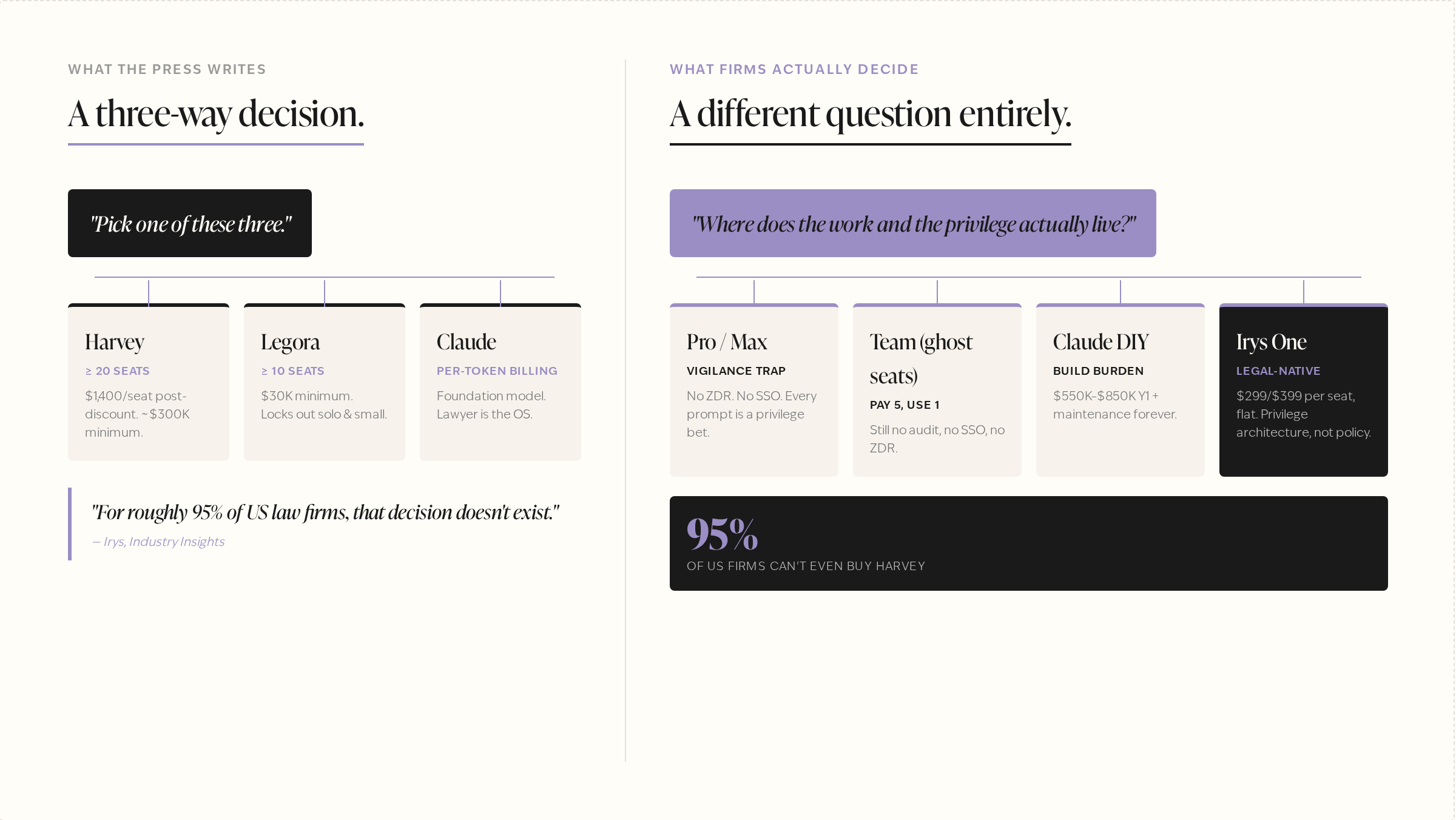
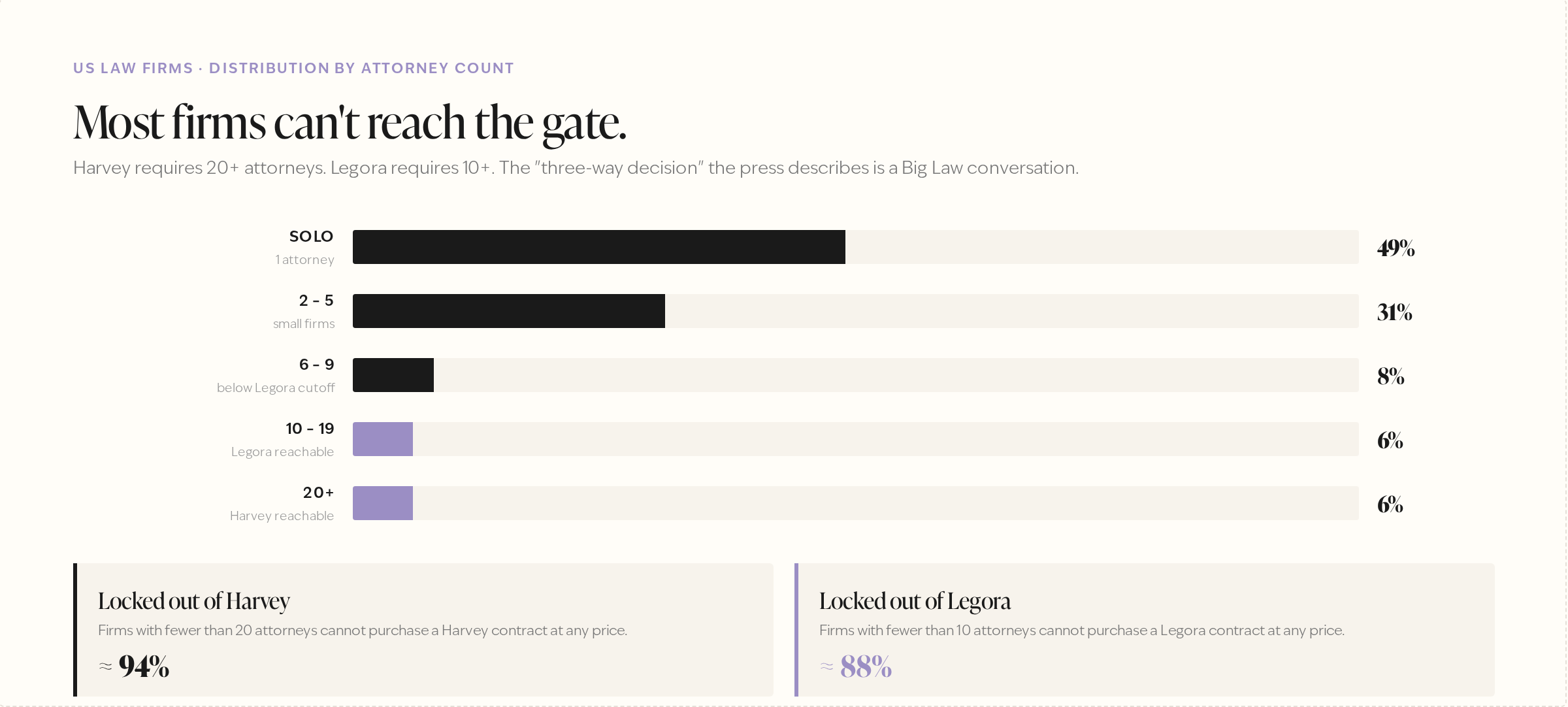
For roughly 95% of US law firms, the legal AI choice the press writes about does not apply. Harvey requires a 20-seat minimum and starts at roughly $300,000 per year.1 Legora requires a 10-seat minimum and $30,000. If fewer than 10, you cannot buy Legora.2 If your firm has fewer than 20 attorneys, you cannot buy Harvey.
Every other firm faces a different conversation. This piece is that conversation.
A note before we start. Some of the cost figures below are Irys analysis, built up from sourced inputs. We label them clearly throughout. Where we cite a specific dollar number on Anthropic plans, the source is Anthropic's own pricing pages and help center. Where we model token spend for legal workflows, that math is ours.
Three things changed the conversation in 2026. Anthropic moved every Claude Enterprise contract to usage-based billing in April.[3,4] A federal judge issued the first decision on AI and attorney-client privilege in February.5 And Claude Cowork shipped without persistent matter memory. Together these reshape the legal AI decision into a sequence of questions a careful managing partner has to answer in order. Each one changes the calculus on the next.
Pro and Max have audit, retention, and contractual gaps that no user toggle fixes.
The relevant ruling is United States v. Heppner, S.D.N.Y., February 17, 2026, Rakoff, J.5 The defendant in Heppner used Claude on his own, without counsel's direction, to draft his defense strategy. The court held those communications were not privileged: "Because Claude is not an attorney, that alone disposes of Heppner's claim of privilege."
The holding is narrower than the headlines made it sound. Judge Rakoff noted in dictum that attorney-directed use might be analyzed differently as a Kovel-style agent. So Heppner did not categorically ban attorney use of Claude. It is unsettled doctrine.
The harder problems for Pro and Max are structural and exist regardless of how Heppner is interpreted. There is no Zero-Data-Retention addendum available on Pro or Max. There is no SSO, no SCIM, no audit logs, no BAA.[7,8] Critically, Pro and Max do not record an audit trail of what was input, when, or how. If a privilege challenge arises later, there is no contemporaneous record to demonstrate that the use was carefully structured.
Anthropic's Consumer Terms govern the Pro and Max relationship regardless of which user toggles are flipped. Anthropic states explicitly that those terms "do not apply to services under Commercial Terms, including Claude for Work."6 Turning off training does not move a Pro or Max user onto Commercial Terms. The contractual data-handling regime is set by the plan, not by user-level switches.
What that means in practice for any attorney trying to use Pro or Max for client-confidential work. Every input is a potential privilege-waiver risk. Each prompt would need to be vetted in real time against waiver doctrine. There is no audit trail to prove how each input was scoped. There is no contractual ZDR commitment. Consumer Terms are the operating contract regardless of personal settings. Attorneys should not have to second-guess every keystroke while they are trying to do their work.
A reasonable attorney can decide whether those gaps are tolerable for their practice. Most firms doing serious risk review conclude they are not.
Most firms cannot buy Harvey or Legora.
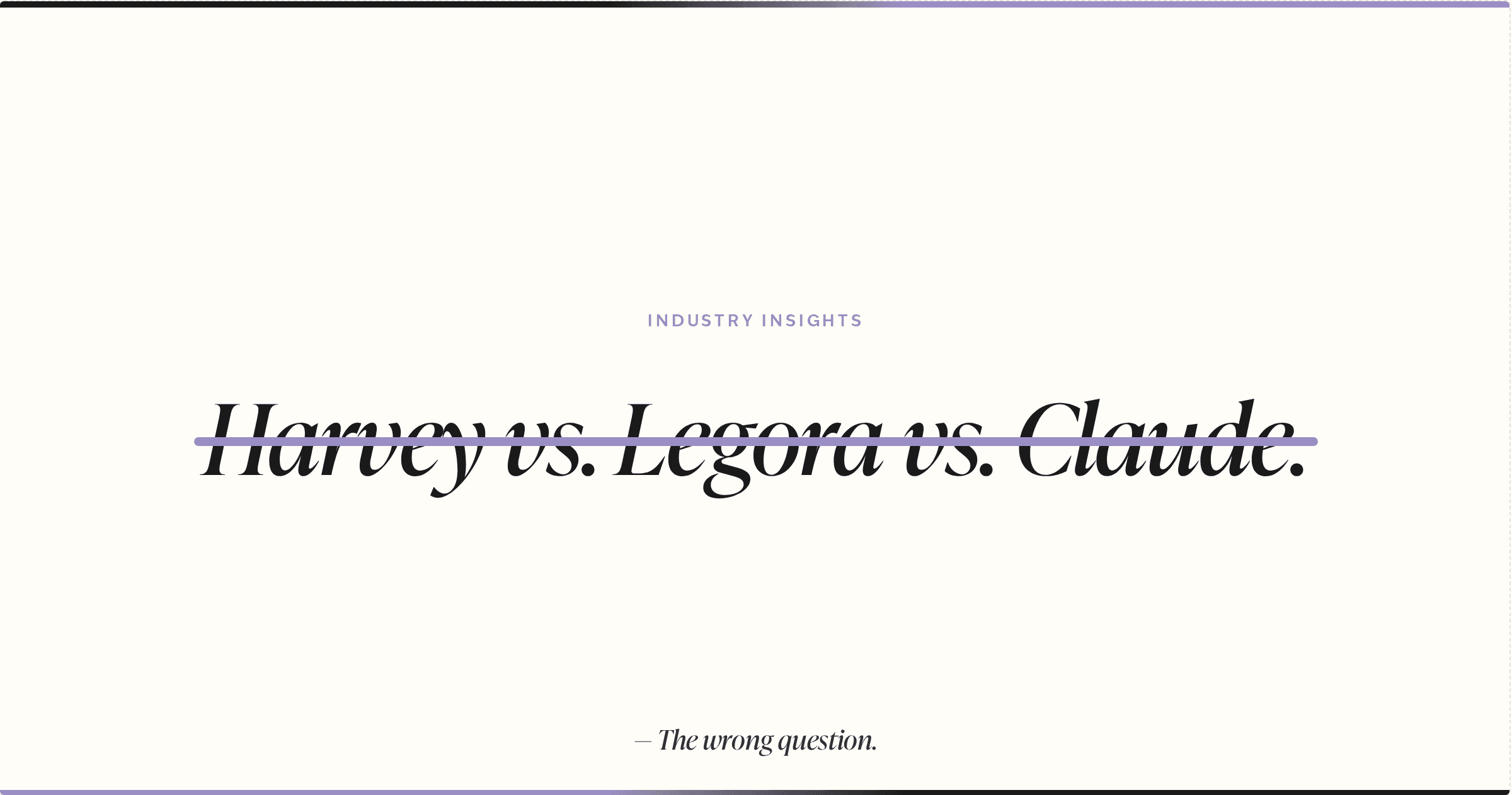
For solo lawyers, boutiques, and mid-market firms under 20 attorneys, neither incumbent will sell. The realistic 2026 choice for those firms is not Harvey vs. Legora vs. Claude. It is Claude vs. a legal-native platform built for the way lawyers actually work.
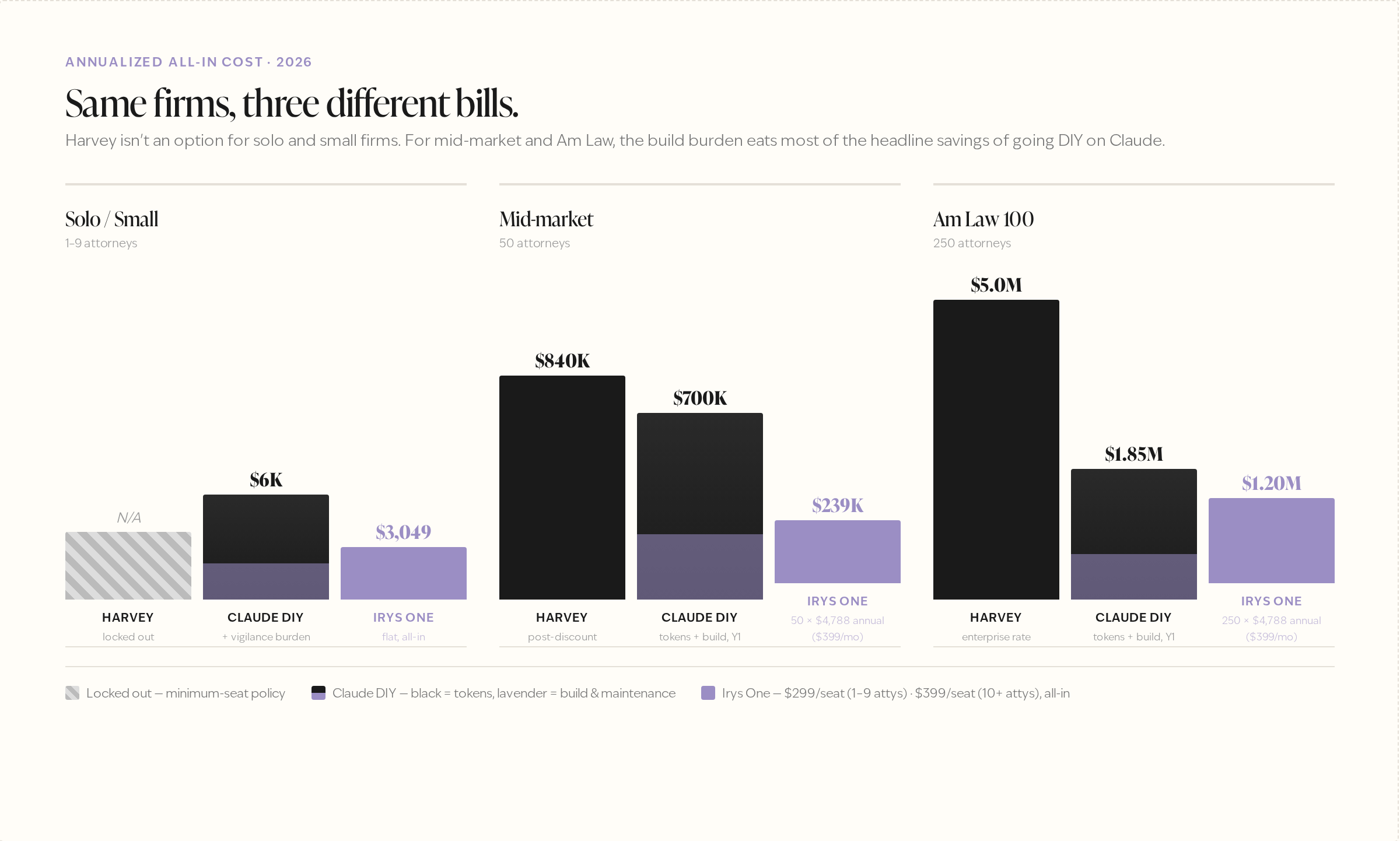
For a 50-attorney firm, Harvey is technically reachable. 50 seats × $1,400 per seat × 12 months is roughly $840,000 per year post-discount.1 For an Am Law 100, the number is over $5 million per year. Both are reachable. Both are also choices about where partner-level money goes: a platform premium, or infrastructure you control.
Cowork has no memory. The lawyer becomes the operating system.
This is the question most firms underestimate, because it does not show up in the procurement spreadsheet.
Claude Cowork has no persistent matter context or firm memory. Every new task starts fresh. To get any continuity, the lawyer has to save key files into project folders, tell Cowork where to look at the start of every new session, and ask it to re-read those files before any new work begins. Cowork re-tokenizes that context every time and bills for it. The model does not know what the firm decided about this matter last week. It does not know the firm's standard positions. When the lawyer leaves, the project structure and the institutional knowledge of how to make Cowork useful walk out the door with them.
This is an architectural property of foundation-model products, not a defect to be patched. A foundation model is a stateless reasoning engine. Persistent matter context, firm memory, accumulated playbooks, and team-shared institutional knowledge are capabilities a firm has to build on top of it. The lawyer ends up doing that work in non-billable time, every day.
The $20 sticker is not the price.
Anthropic moved every Claude Enterprise contract to usage-based billing in April 2026.[3,4] The $20 per seat per month covers platform access. Every input and output token is billed on top at standard API rates: $3 per million input and $15 per million output for Sonnet 4.6.3
Anthropic's own published Claude Code benchmark is roughly $13 per active day and $150 to $250 per developer per month.9 That number is from software engineers. Legal Cowork is heavier on every dimension that matters. PDFs and exhibits ingest at 8K to 300K tokens before a question is asked. Citation-grounded research expands a single turn to 50K to 150K input tokens. Cowork is agentic, so a "review this contract against our playbook" task can consume 100K+ tokens by itself.
Realistic monthly all-in cost bands for legal Cowork on Claude Enterprise (Irys analysis, built up from Anthropic's own benchmark and Sonnet 4.6 list pricing):
- Light. Occasional partner using AI sparingly. $300 to $500 per seat per month.
- Moderate. Typical associate, daily use on real matters. $600 to $1,200 per seat per month.
- Heavy. Litigator or transactional partner doing daily document-heavy work. $1,200 to $2,500 per seat per month.
- Very heavy. M&A lead or complex-litigation matter lead. $2,000 to $4,000+ per seat per month.
The honest reading is this. The $20 sticker is fiction for any attorney doing real practice work. Real all-in lands $400 to $2,000+ per seat per month, and well above for partner-level token-heavy practice.
The build burden absorbs the headline savings.
Raw Claude is the foundation-model layer only. Legal-specific skills and playbooks, citation verification, matter-centric context and firm memory, jurisdictional research grounding, audit trails, onboarding, governance, integration build and ongoing maintenance against firm systems, skill versioning across every model release, and a Word integration where lawyers actually live, all of it lives above Level 1.
Conservative annualized cost (Irys analysis, built up from line-item assumptions any reader can check):
- Legal engineering and skill maintenance. 0.5 to 1.5 FTE at $200K fully loaded. $150K to $300K per year.
- Integration maintenance. iManage or NetDocs, Westlaw or Lexis, Outlook, billing, e-sign, conflicts. 3 to 6 critical integrations at roughly $40K per year per integration ongoing. $120K to $240K per year.
- Skill and prompt versioning across model releases. 3 to 4 Claude releases per year, each requiring regression testing, re-prompting, edge-case handling. $50K to $120K per year.
- Citation, audit, and jurisdictional vendor stack. Third-party licenses for citation verification, audit logging beyond Claude Enterprise baseline, jurisdictional research. $50K to $150K per year.
- Onboarding, change management, IT governance. Training plus 0.25 FTE security or IT ownership for token-budget alerts and model-selection policy. $50K to $150K per year.
Roll-up.
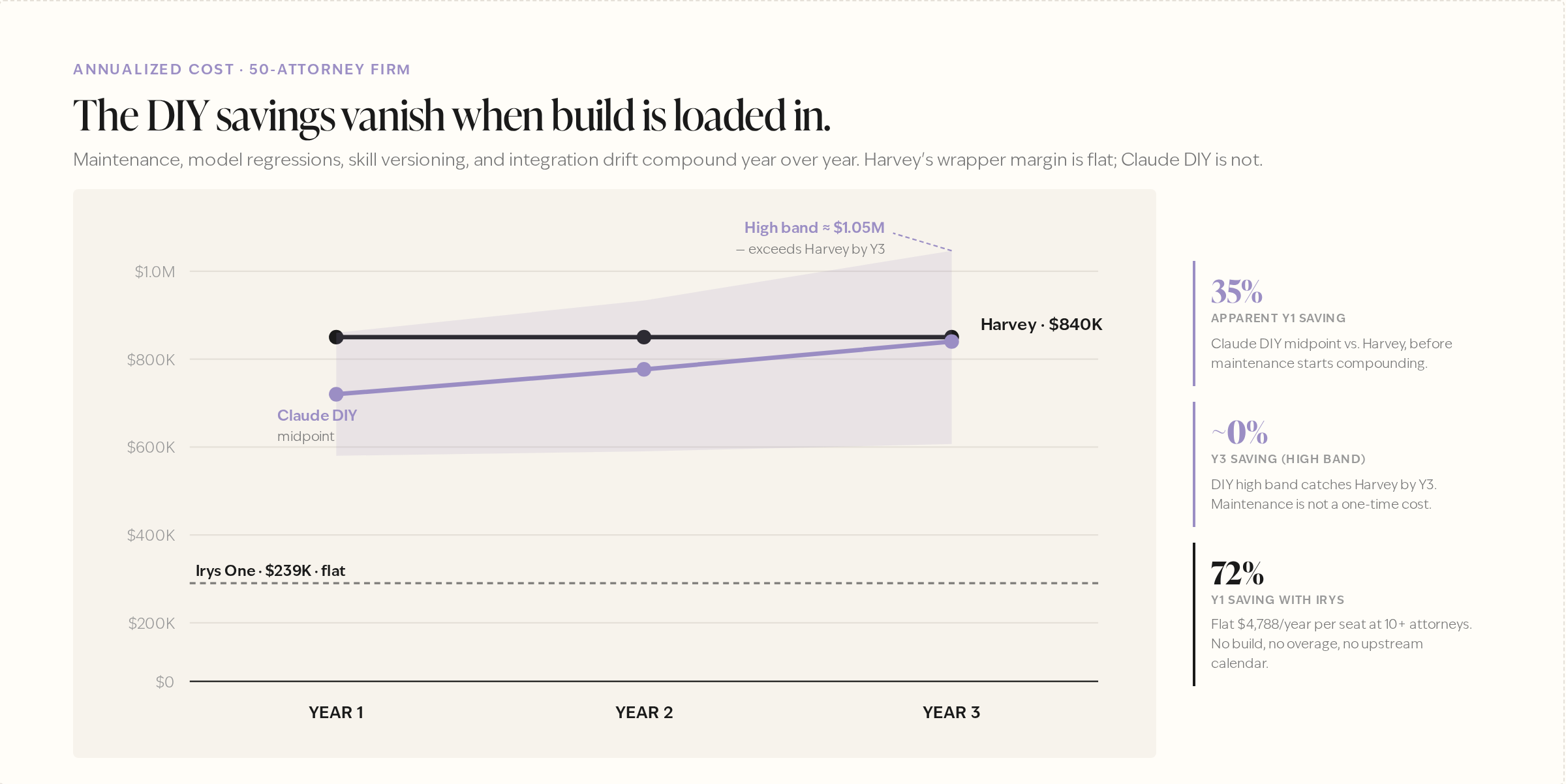
- Mid-market 50 attorneys. Year 1 (incl. initial build) $600K to $900K. Year 2+ ongoing $400K to $700K per year.
- Am Law 100 250 attorneys. Year 1 (incl. initial build) $900K to $1.5M. Year 2+ ongoing $700K to $1.2M per year.
The Harvey-replacement math therefore lines up like this. Harvey post-discount: $840K per year for a 50-attorney firm. Claude DIY: $150K tokens at moderate-associate average plus $400K to $700K build, totaling $550K to $850K year-one, with maintenance continuing indefinitely. Raw Claude looks like an 80% saving on paper. Once the build is loaded in, the comparison narrows fast.
Every Anthropic model release becomes an unscheduled engineering project.
Five Anthropic model releases in the past six months. Each one means regression-testing every custom skill, re-tuning prompts that drift, handling new edge cases, re-running integration tests, and explaining to partners why yesterday's workflow is producing different output today. The firm did not choose any of these projects. They show up on the calendar whether or not the firm has the engineering capacity for them.
Vendors amortize this work across hundreds of customers. A single firm absorbs it alone. Integrations and skills are not set-it-and-forget-it infrastructure. They are living dependencies that break with every upstream change.
A firm choosing to run its own Claude stack is choosing to inherit a delivery calendar set by Anthropic, not by the firm.
The decision your firm is actually making.
For a solo or small firm. Harvey and Legora are not options. Pro and Max have the audit, retention, and contractual gaps described above. Claude Team forces you to pay for 5 seats and use 1, and Team still has no SSO, no audit, no ZDR.7 Your real decision is Team-with-ghost-seats vs. a legal-native platform built for your actual practice.
For a mid-market firm. Harvey is reachable but expensive. Claude DIY runs $550K to $850K year-one, with maintenance continuing indefinitely. Your real decision is whether to absorb the engineering team and the maintenance calendar, or buy a platform that already includes them.
For an Am Law 100. Harvey is $5M+ per year. Claude DIY is $1.6M to $2.1M year-one and continues to scale. Your real decision is whether the platform premium or the build burden is the better use of partner-level money.
The underlying question in every case is the same. What should attorneys be spending their time on? The right answer is the practice of law. Not maintenance of a Claude integration that breaks every quarter. Not real-time vetting of every prompt for waiver risk. Not manual re-uploading of context Cowork forgot since last Tuesday.
The real decision is whether to keep paying for the press's three-way comparison, or to make the comparison that actually applies to your firm.
Sources
- [1] AI Vortex, Harvey AI Pricing (2026): Plans, Seat Cost & Real Contract Sizes. aivortex.io/legal/ai-tools/harvey-ai-pricing-2026
- [2] Purple Law, The Outrageous Price of Legal AI: Why Harvey and Legora's Tactics Reveal a Deeper Problem. purple.law/blog/harvey-vs-legora-pricing
- [3] Thomas Claburn, Anthropic ejects bundled tokens from enterprise seat deal, The Register (Apr. 16, 2026). theregister.com/2026/04/16/anthropic_ejects_bundled_tokens_enterprise
- [4] PYMNTS, Anthropic Switches to Usage-Based Billing for Enterprise Customers (2026). pymnts.com/.../anthropic-switches-to-usage-based-billing
- [5] United States v. Heppner, S.D.N.Y. (Rakoff, J., Feb. 17, 2026). Discussed in Harvard Law Review (Mar. 2026), harvardlawreview.org/blog/2026/03/united-states-v-heppner.
- [6] Anthropic, Updates to Consumer Terms and Privacy Policy. anthropic.com/news/updates-to-our-consumer-terms
- [7] Anthropic Help Center, What is the Team plan? support.claude.com/.../what-is-the-team-plan
- [8] Anthropic Help Center, What is the Enterprise plan? and How am I billed for my Enterprise plan? support.claude.com/.../what-is-the-enterprise-plan
- [9] Anthropic Claude Code Docs, Manage costs effectively. code.claude.com/docs/en/costs
---
Go deeper on the platforms discussed here: an independent, sourced [Harvey vs Legora comparison](/compare/harvey-vs-legora), the same treatment for [Harvey vs CoCounsel](/compare/harvey-vs-cocounsel), and the [Harvey AI pricing guide](/guides/harvey-ai-pricing) separating what is confirmed about Harvey's cost from what circulates unverified.